

This is a frequent inquiry in the realm of slots, and the brief response is:
A casino may occasionally present a slot with a different RTP version, but it generally cannot modify RTP on a spin-by-spin basis or during your gameplay session.
This distinction is significant.
Numerous contemporary slots come in multiple RTP settings. The game provider might offer several sanctioned versions of the same title, such as 96.5%, 95%, or 94%. A casino can then select which sanctioned version to implement on its platform, based on its arrangements and commercial contracts.
This is quite different from the notion that a casino can observe a player in real-time and manually "reduce RTP" during gameplay. Standard slot operation does not function in that manner.
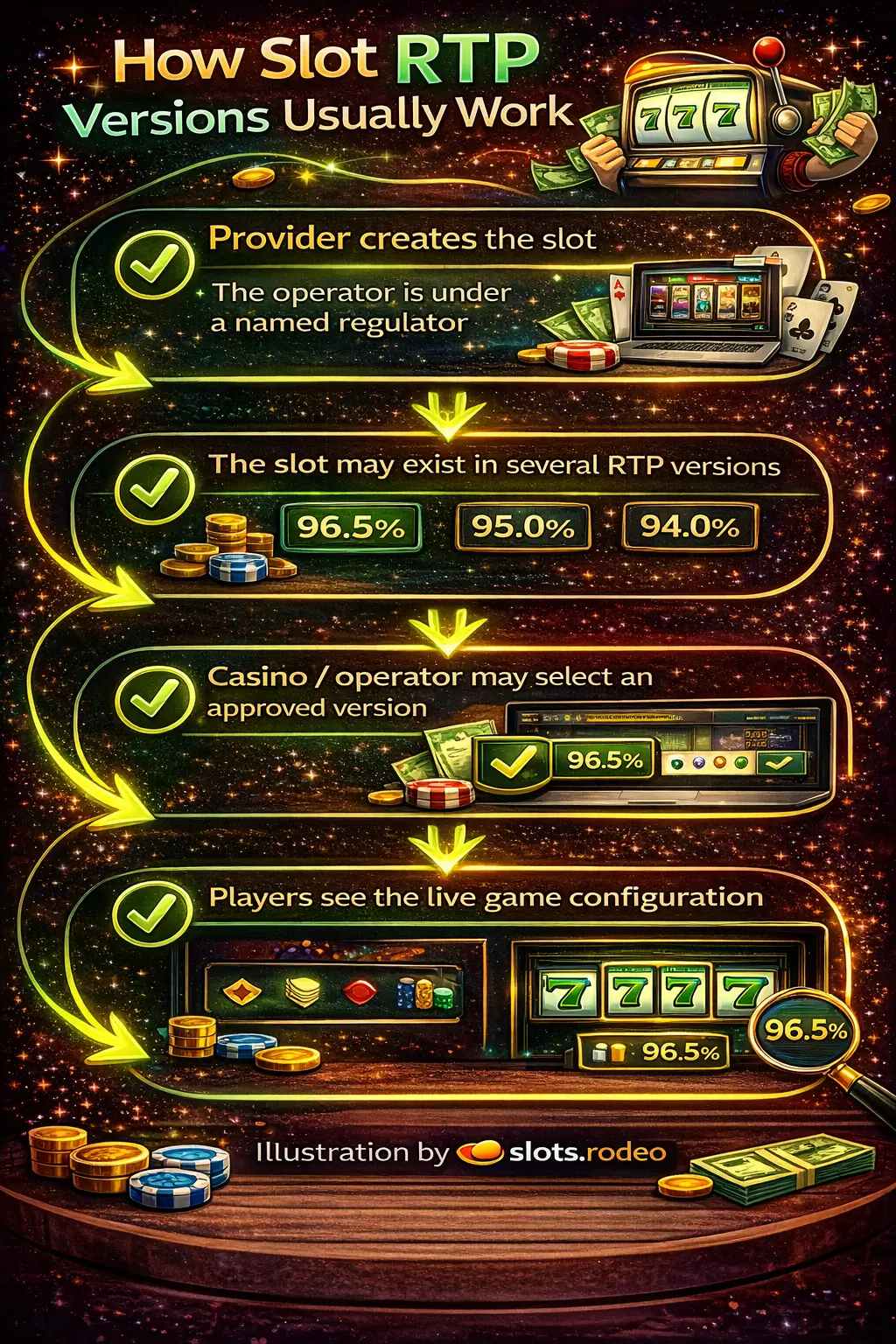
Understanding RTP in this Context
RTP, or Return to Player, represents the long-term theoretical return embedded within a slot's mathematical model.
When a slot version is configured at:
- 96%
- 95%
- 94%
this percentage signifies the long-term theoretical return for that particular version.
The crucial point is thatRTP is associated with the game configurationrather than with an individual session.
Thus, when individuals inquire if a casino can "alter RTP," the underlying question typically involves one of these:
- can the casino select from different RTP versions of the same slot?
- can the casino decrease RTP while I'm playing?
- can the casino independently manage RTP?
These questions are not identical.
The most precise straightforward response
A helpful way to conceptualize it is as follows:
| Question | Usual answer |
|---|---|
| Can the same slot be available in multiple RTP versions? | Yes, often |
| Can a casino opt for which approved version to present? | Often yes |
| Can RTP be altered during a spin? | No, that is not how standard slot operation works |
| Can a casino independently modify provider mathematics? | Usually no |
| Can one casino have a lower RTP version compared to another for the same slot? | Yes, that can happen |
Can the same slot be available in multiple RTP versions?
Can a casino opt for which approved version to present?
Can RTP be altered during a spin?
Is it possible for a casino to independently modify provider mathematics?
Can one casino present a lower RTP variant of the same slot than another casino?
This explains why two casinos can feature the same slot title but might not offer identical theoretical returns.
Understanding slot RTP versions
Often, the provider develops the slot in multiple predetermined RTP variants.
For instance, a single title might be available as:
- 96.2%
- 95.1%
- 94.0%
While the visual aesthetic, theme, paytable structure, and essential feature mechanisms may appear nearly the same, the foundational mathematical profile is adjusted for a different long-term return percentage.
A casino can then implement one of those sanctioned versions.
This indicates that the casino typically selectsfrom the available variantsrather than creating a new RTP figure independently.
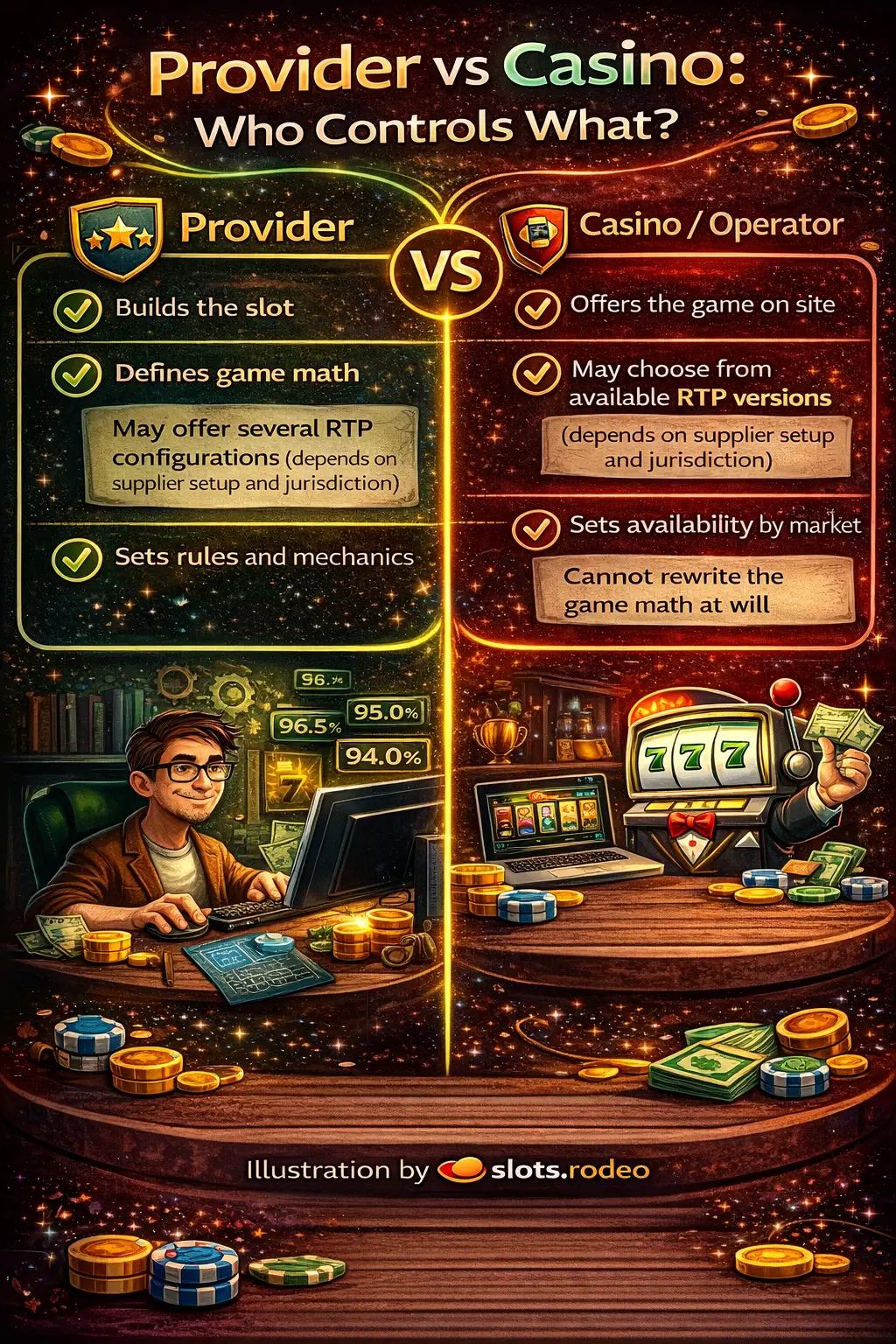
Provider versus casino: who has authority over what?
This is where numerous misconceptions arise.
The provider and the casino generally do not oversee the same elements.
| Area | Provider usually controls | Casino usually controls |
|---|---|---|
| Mathematical model of the game | Yes | Usually no |
| Sanctioned RTP variants | Yes | Usually no |
| Which sanctioned version is presented | Sometimes no | Often yes |
| Outcomes of live sessions | No manual control per player | No manual control per player |
| Logic of in-game features | Yes | Usually no |
| Availability of the game for players | No | Yes |
Mathematical model of the game
Sanctioned RTP variants
Which sanctioned version is presented
Outcomes of live sessions
Logic behind in-game features
Availability of games for players
The provider generally supplies the slot along with its designated RTP settings. While the casino can select which version to display, this does not equate to altering the mathematical structure at will.
Is it possible for a casino to alter RTP during gameplay?
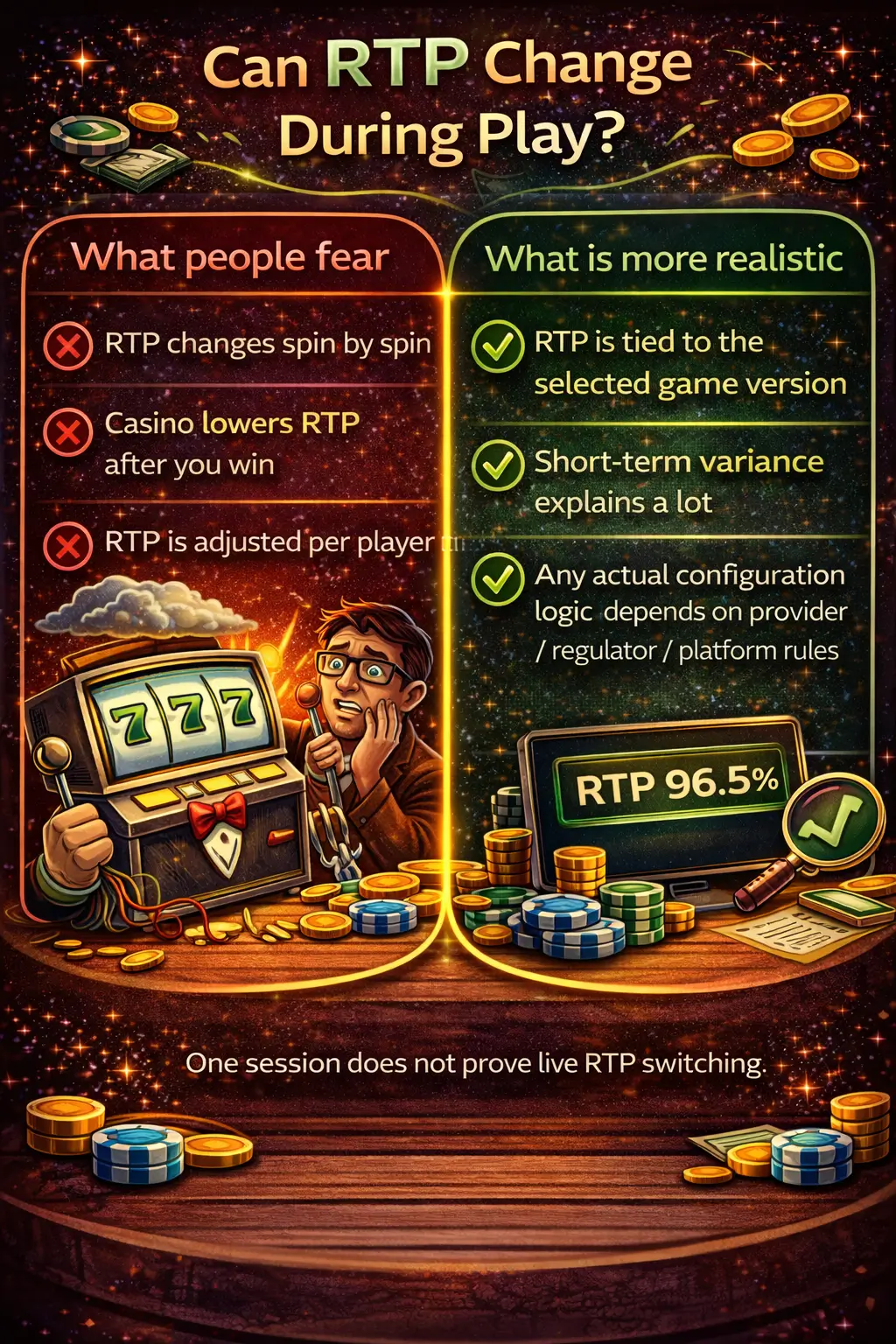
Under standard slot functionality, RTP isnot meant to fluctuate during your live sessionsimilar to a volume control.
That means:
- it should not change from one spin to another
- it should not be influenced by your wins or losses
- it should not be adjusted manually if a player is winning
- it should not abruptly change mid-way through a bonus round
This represents one of the largest misconceptions in slot discussions.
A session on a slot does not function this way:
- the player begins winning
- the casino decreases RTP
- the player starts losing
- the casino increases RTP afterwards
That is not how conventional game settings are intended to function.
Reasons why players believe RTP varies during gameplay
This notion often arises from variance experienced in short sessions.
A player might experience:
- a highly successful session
- a particularly poor session
- a bonus that performs exceptionally well once and poorly the next time
- extended periods of losses following previous wins
This can create the impression that RTP has changed during play.
However, RTP serves as a theoretical measure over the long term. Brief gaming sessions may show significant fluctuations without any alterations to the RTP.
This distinction clarifies that session outcome and RTP version are not equivalent.
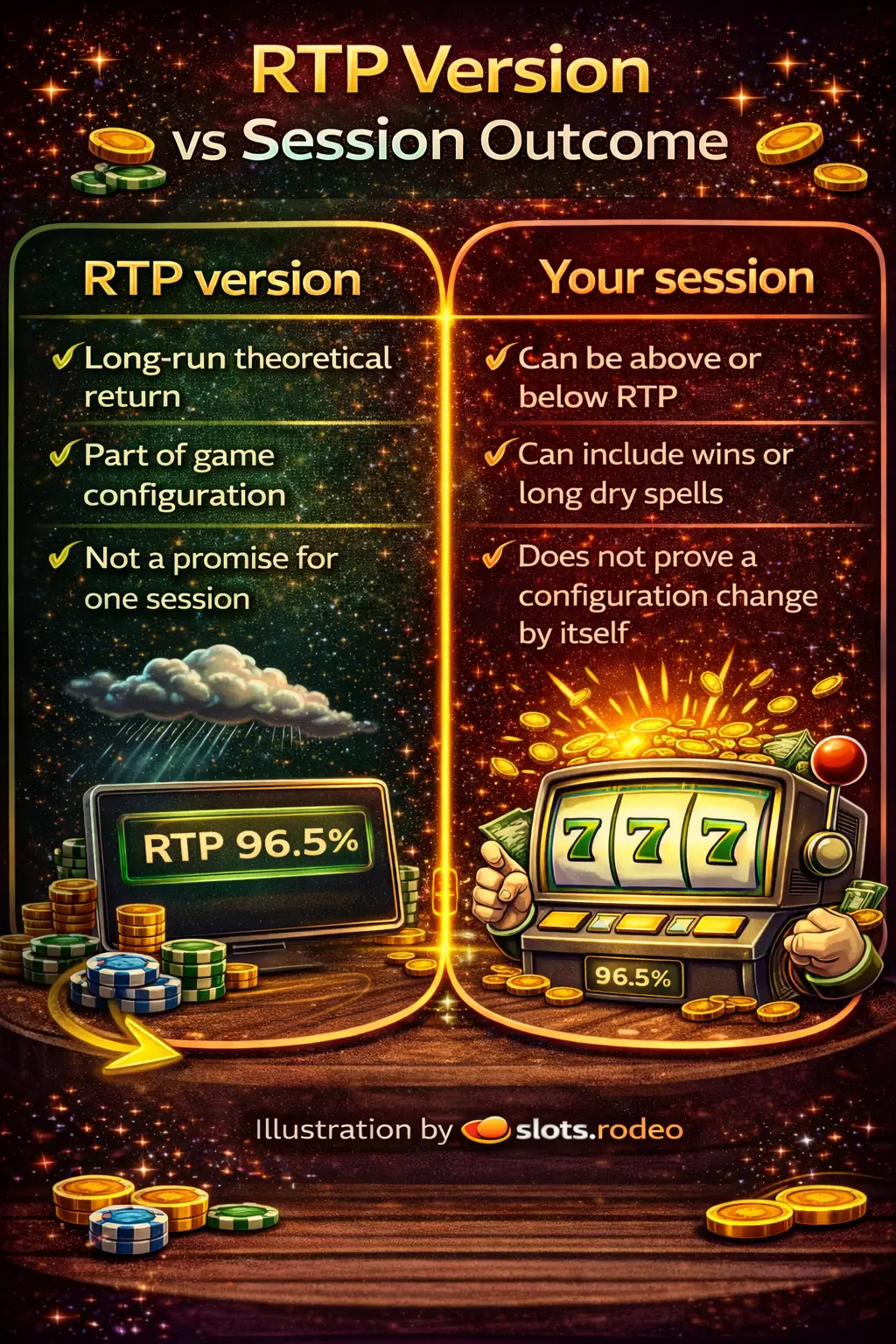
RTP version compared to session outcome
Understanding this distinction is crucial.
| Concept | What it means |
|---|---|
| RTP version | The long-term theoretical return setting of that slot version |
| Session outcome | What happened in your short sample of spins |
RTP version
Session outcome
A poor session doesnotindicate that the RTP was potentially reduced.
A favorable session doesnotindicate that the slot was likely operating at a higher setting.
A slot with a 96% RTP can still yield a disappointing short session, while a lower-RTP variant can deliver impressive short-term outcomes. Short-term performance does not inherently reveal the game's configuration.
Is it possible for RTP to vary across casinos?
Indeed. This aspect is particularly relevant for players.
The same slot title may be offered:
- at one RTP version in Casino A
- at a different RTP version in Casino B
While the slot's name and appearance may remain consistent, the theoretical return can vary if a different approved version is utilized.
This highlights why it's insufficient to compare slots based solely on their titles.
Can RTP vary between countries or brands?
Occasionally, yes.
A provider might deliver different versions based on:
- casino preferences
- regulatory market requirements
- brand policies
- platform configurations
- commercial arrangements
Players may still encounter the same game title and visual styling, despite variations in the underlying RTP setup.
Thus, the in-game help section becomes more significant than mere reputation or conjecture.
Common limitations for casinos
Clarity is essential here.
Casinos typicallycannotoperate under the following principles:
- adjust RTP for an individual player when they are winning
- reduce RTP midway through a feature
- alter the math on a per-spin basis
- modify provider logic directly from the lobby interface
- utilize a live "tighten the slot now" feature in a conventional manner
These concepts are prevalent myths; they do not accurately reflect the standard operation of slot deployment.
What casinos could potentially do
What casinosmaycan actually do is much more limited.
They may have the ability to:
- select from approved RTP versions provided by the game developer
- determine which version of a slot to feature on their platform
- swap one slot version for another at a broader setting level
- add or remove a game from the lobby
This is not equivalent to dynamically altering the RTP against a player during active gameplay.
Can RTP fluctuate during gameplay? The practical response
The practical response is:
A casino might present a lower or higher approved version of a slot before you commence playing, but this does not indicate that the RTP is being modified live during your gaming session.
This key distinction clarifies much of the confusion.
Why the same slot can appear different without any change in RTP
Players frequently compare two separate sessions and assume RTP has shifted because the slot seemed different.
However, a session may feel different due to:
- bonus timing
- multiplier connections
- hit rhythm
- variance in short play
- feature-rich value concentration
- ordinary randomness within the game model
This is significant because "felt different" does not constitute proof of a live RTP alteration.
What to verify if RTP is important to you
If RTP is significant to you, concentrate on practical verifications rather than myths.
| What to check | Why it matters |
|---|---|
| in-game help section | This is often where the actual RTP is shown |
| Exact RTP figure, if available | Confirms the version more reliably than general reputation |
| Identical slot games available across various casinos | Helps you see whether the title may be offered at different versions |
| Information about the provider and the paytable interface | Useful for confirming that the game version is the one actually being played |
| Comparison of declared RTP versus the actual displayed RTP | Prevents false conclusions from one short result |
In-game assistance interface
Precise RTP figure, if it is provided
Identical slot games available across various casinos
Information about the provider and the paytable interface
Comparison of declared RTP versus the actual displayed RTP
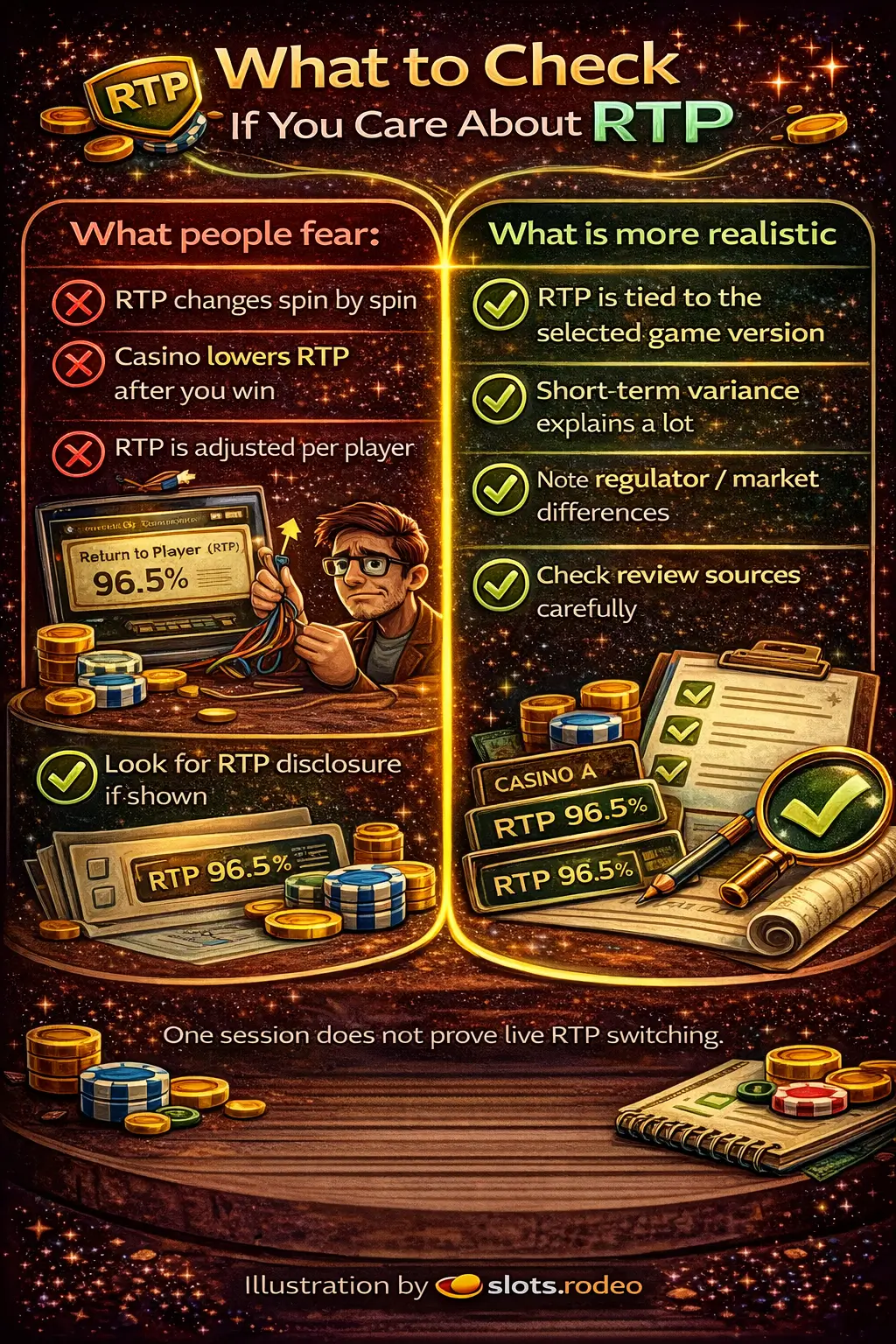
What to avoid relying on
To accurately comprehend RTP, these notions should not be trusted:
- "the slot was generous yesterday, so the RTP must have been higher"
- "my bonus was poor, indicating the casino altered the settings"
- "the slot became less favorable after a significant win, indicating a drop in RTP"
- "a brief session can validate the version in use"
- "the same slot title universally means the same RTP across the board"
These conclusions lack strength.
Frequent errors made by beginners
Mixing up RTP version with session outcomes
A poor run does not indicate a lower configuration.
Believing that casinos directly control every aspect of slot mathematics
Typically, the provider governs the game mathematics and the approved versions.
Assuming RTP fluctuates in real-time during gameplay
Regular slot functionality does not operate like an instant adjustment dial.
Believing that identical slot titles always share the same RTP
Different online casinos might provide various approved versions.
Disregarding the information screen within the game
This is frequently the optimal location to verify the actual RTP for that specific game.
A straightforward illustration
Consider that the same slot title is available in three distinct approved versions:
- 96.1%
- 95.0%
- 94.0%
Casino A has the 96.1% RTP version.
Casino B has the 94.0% RTP version.
Now picture a player experiences a disappointing session at Casino A and a favorable one at Casino B.
That doesnotThis demonstrates that Casino B has a better RTP in practice for that player's short-term experience. It simply indicates that short sessions can fluctuate. The actual configuration is still crucial, but the results of the session alone cannot confirm it.
The practical implications of this
The most precise takeaway is:
- casinos may occasionally select among provider-approved RTP versions
- thus, the same slot can vary between different casinos
- this does not imply that RTP is dynamically altered during your gameplay
- short-session outcomes are too variable to demonstrate real-time RTP changes
That is the accurate perspective.
FAQ
Frequently asked questions on this subject.
They can sometimes opt between approved RTP versions of a slot, but generally do not dynamically alter RTP during your session.
Indeed. The same slot title may sometimes be available in varying approved RTP versions at different casinos.
In regular operation, no. RTP is typically linked to the chosen game setup, not adjusted on a spin-by-spin basis during play.
No. A poor short session does not serve as proof of a real-time RTP modification.
The provider generally governs the game mechanics and authorized RTP versions. The casino often decides which approved version to present.
