

Walking Wilds Explained
Awalking wildis a wild symbol that does not stay fixed in one position. Instead, itmoves across the reels or grid over consecutive spins or feature steps.
In simple terms, the wild lands, remains active, and then shifts to a new position on the next reel action according to the game rules. That movement can continue for several spins, often during free spins or a bonus feature.
This matters because the wild is not only helping on the current result. It is also changing the structure of later spins as it travels across the layout.
What "walking" means in slot mechanics
A regular wild usually affects one result and then disappears. A sticky wild stays in one place. A walking wild does something different: itkeeps its presence but changes location.
The most common version looks like this:
- a walking wild lands
- it stays active for the next spin
- it shifts one reel to the left or right
- the next spin starts with the wild in its new position
- the movement continues until the feature ends or the wild exits the screen
That is why the mechanic is called "walking." The symbol moves step by step through the reel layout instead of remaining static.
| Wild type | Main behavior | What changes over time? |
|---|---|---|
| Regular wild | Helps on one result | Nothing carries over |
| Sticky wild | Stays in one fixed position | Duration |
| Walking wild | Remains active but moves | Position |
Regular wild
Sticky wild
Walking wild
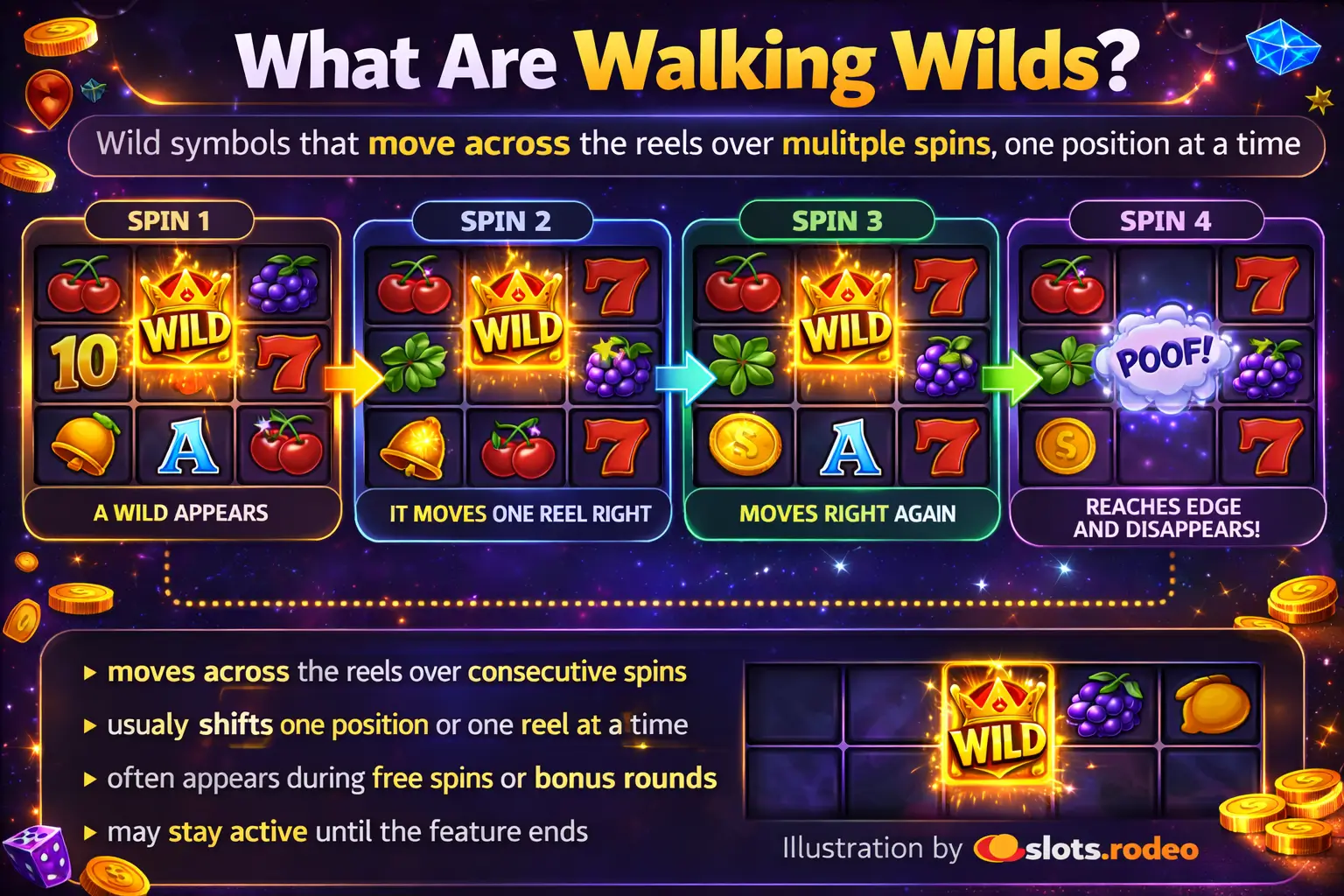
Understanding the mechanics of walking wilds
This mechanic can be described as a sequence of events.
A wild symbol appears or is activated
The feature can initiate when a special wild symbol is present in the base game, during free spins, or within another bonus feature.
The wild remains active
Rather than vanishing after the outcome is calculated, the wild stays in play for subsequent reel actions.
The wild progresses
In the following spin or feature stage, the wild shifts according to the specific game mechanics. In numerous slots, it advances one reel at a time, while in others, it may follow a set movement pattern across positions.
The surrounding reels adjust accordingly
As the wild moves, it continues to be part of the active display while other symbols change.
Movement concludes based on specific rules
Typically, the walking sequence halts when:
- the feature round concludes
- the wild reaches the final reel
- the wild exits the screen
- the slot triggers a specified bonus event
This indicates that the mechanic encompasses more than mere substitution. It also involvesadvancement on the screen.
Common movement patterns observed
Different slots may employ varying walking rules. Here are the most prevalent types:
| Movement pattern | How it behaves |
|---|---|
| Reel-to-reel movement | Wild moves one reel left or right each spin |
| Row-based movement | Wild moves across positions in the same row |
| Full-reel movement | An expanded or stacked wild shifts as one block |
| Feature-exclusive path | Wild follows a scripted route during a bonus |
| Multi-wild movement | More than one walking wild moves at the same time |
Reel-to-reel movement
Row-based movement
Full-reel movement
Feature-exclusive path
Multi-wild movement
When a slot refers to 'walking wilds,' the crucial aspect is not only their movement butthe manner and duration of their movement.
Common applications of walking wilds
Walking wilds frequently occur in features designed for players to experience a clear progression from one spin to the next.
They typically show up in:
- free spins features
- bonus rounds with reel advancement
- wild-centric respin options
- mechanics focused on expanding reel coverage
- slots where movement itself is integral to the feature
They are not often seen as a standalone base game mechanism since their value arises fromcontinuity across multiple reel actions.
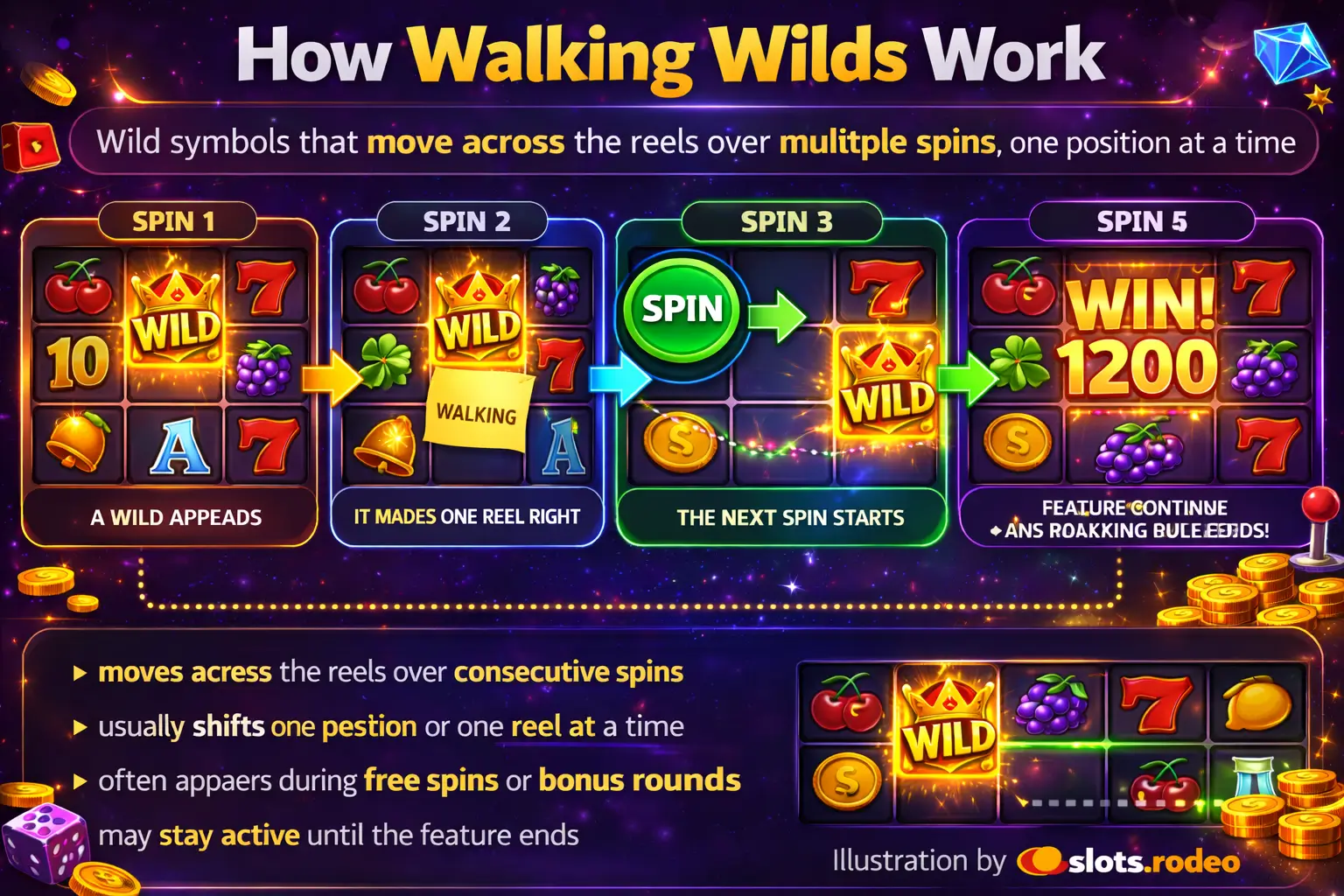
Impact of walking wilds on winning potential
While a walking wild does not assure a win, it enhances the dynamism of a feature more than a static wild would.
Its effectiveness hinges on:
- the starting reel position
- the movement direction
- the number of spins left
- the possibility of additional walking wilds appearing
- the wild's configuration—single-position, stacked, or expanded
- how the slot's payout structure leverages reel connections
A walking wild can gain value as it approaches central reels, or lose value if it appears late in the feature. Timing is as crucial as positioning.
Significance of movement
A sticky wild is beneficial by remaining in a strategic location. A walking wild providesvaried strategic locations over time.
This can be significant when the slot aims to:
- unlock diverse payline connections across multiple spins
- cover more of the reel layout
- show visible accumulation during free spins
- turn one wild event into a multi-spin mechanic
Walking wilds are often tied to free spins
This is where the mechanic is easiest to read.
A common feature structure looks like this:
| Spin in feature | What happens |
|---|---|
| Spin 1 | Walking wild lands |
| Spin 2 | Wild moves one reel and stays active |
| Spin 3 | Wild moves again |
| Later spins | Movement continues until the rule ends |
Spin 1
Spin 2
Spin 3
Later spins
This works well in free spins because the player can see the wild advancing through the round. It gives the bonus a sense of progression without making the rules too complicated.
Some slots also add:
- extra free spins when a walking wild appears
- more than one walking wild at once
- stacked walking wilds
- multipliers attached to the moving wild
- expanding movement patterns during the feature
Not all walking wilds are single symbols
A walking wild can appear in different forms:
| Walking wild format | What moves |
|---|---|
| Single-position walking wild | One wild symbol changes reel or position |
| Stacked walking wild | A vertical stack moves together |
| Full-reel walking wild | A full reel of wild coverage shifts across the screen |
| Modified walking wild | The moving wild carries a multiplier or other effect |
Single-position walking wild
Stacked walking wild
Full-reel walking wild
Modified walking wild
This matters because a stacked or full-reel walking wild can reshape the screen much more strongly than a one-position version.
Walking wild vs sticky wild vs expanding wild
These mechanics are interconnected as they all pertain to enhanced wild functions, yet they operate in distinct manners.
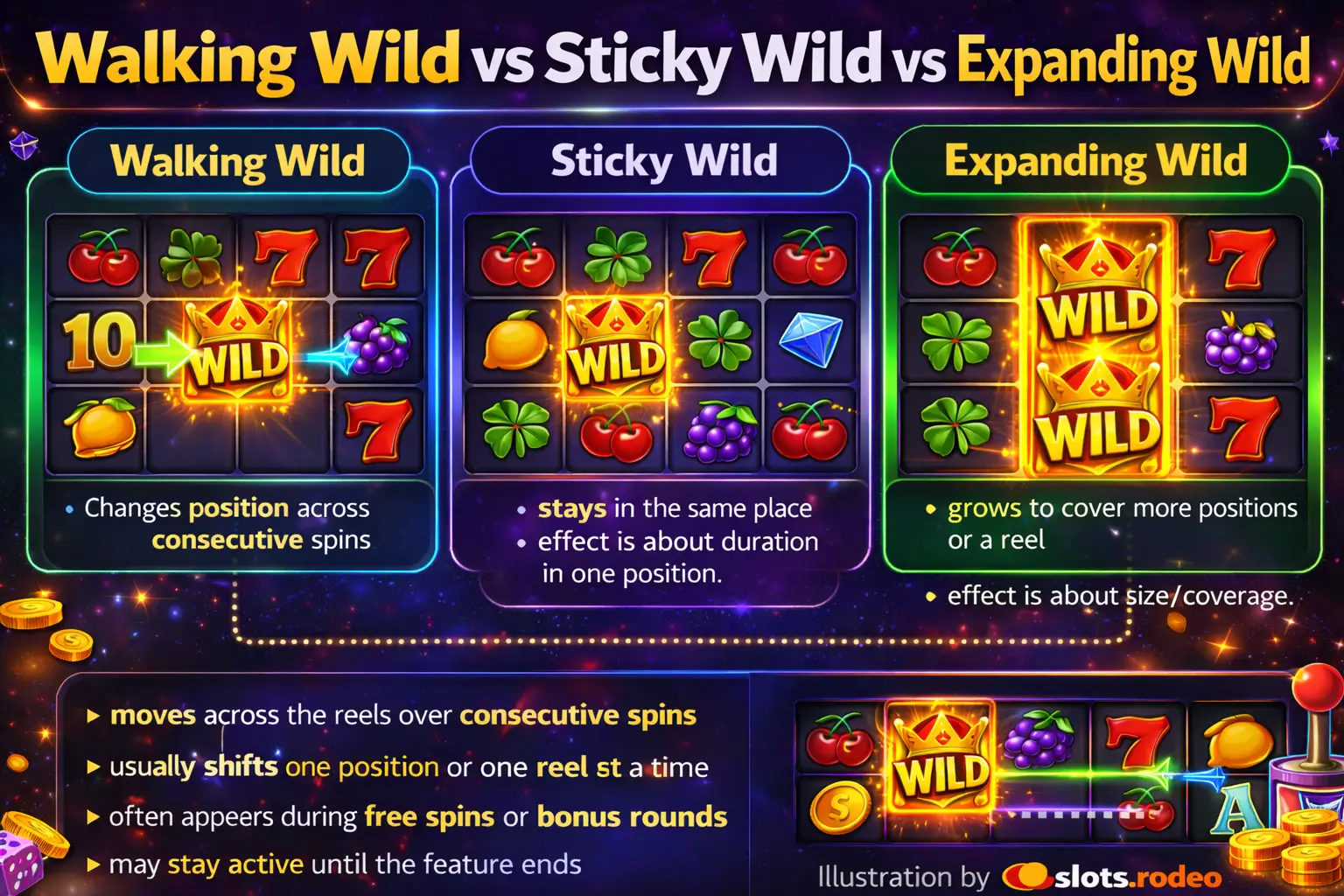
| Wild type | Main effect | What changes? | Typical use |
|---|---|---|---|
| Walking wild | Moves across later spins | Position | Free spins, progressing bonus features |
| Sticky wild | Stays active in one spot | Duration | Feature buildup across several spins |
| Expanding wild | Covers more positions at once | Screen coverage | Reel or area transformation |
Walking wild
Sticky wild
Expanding wild
The primary distinction is as follows:
- walking wild= movement
- sticky wild= stability in one location
- expanding wild= broader coverage
A slot can integrate these concepts. For instance, a walking wild may appear stacked, or a full-reel wild could exhibit traits of both walking and expanding mechanics.
What to verify in the paytable or help section
While walking wilds seem straightforward, the specifics are crucial.
| What to check | Why it matters |
|---|---|
| Initial appearance of the walking wild | Starting position affects later value |
| Direction of movement | Left-to-right and right-to-left movement can play differently |
| If it shifts every spin | Some versions move only during a defined feature state |
| If it remains for the entire feature | Duration changes total impact |
| If additional walking wilds can emerge | Multiple moving wilds can reshape the feature |
| If it is single, stacked, or full-reel | Strongly affects screen coverage |
| If it includes multipliers or additional effects | Sometimes the added modifier matters more than the movement |
Initial appearance of the walking wild
Direction of movement
If it moves with every spin
If it remains throughout the entire feature
If additional walking wilds can emerge
Whether it appears as single, stacked, or full-reel
If it includes multipliers or other enhancements
These elements tend to hold more weight than the label of the feature.
A straightforward illustration
Envision a slot game featuring 8 free spins:
- on the second spin, a stacked walking wild appears on reel 2
- on the third spin, that stack moves to reel 3
- on the fourth spin, it shifts to reel 4
- with each spin, the remaining screen adjusts around it
- the wild keeps moving until the bonus concludes or the rules dictate its exit from the layout
In this scenario, the same wild event can affect several different reel combinations throughout the feature.
The rationale behind using walking wilds in slots
Walking wilds are favored because they providevisible movement that offers continuous value. Players can easily track the mechanic, making the feature feel dynamic despite its straightforward rules.
They are particularly beneficial when a slot aims for:
- bonus rounds that exhibit clear advancement
- wild effects that evolve over time
- a more pronounced visual identity in free spins
- a mechanic that shifts its position rather than merely altering size or duration
They serve as a prime example of a mechanic that enhances movement without complicating the slot's readability.
FAQ
Frequently asked questions regarding this subject.
Not necessarily. Some wilds persist throughout the feature, while others may only remain for a certain number of spins or until they leave the reel layout.
No. Sticky wilds remain static, whereas walking wilds are active yet shift to different positions.
Yes. Certain slots incorporate stacked or even full-reel walking wilds instead of just single-location versions.
No. While they are predominantly found in free spins and bonus rounds, some slots can utilize them in various other special feature conditions as well.
No. They alter the structure of features and can enhance future reel configurations, but the actual payout is still reliant on symbol arrangement, the pay system, and the timing of the features.
