

Certain slot games do not utilizepaylinesorways to win. Instead, they provide payouts when matching symbols create acluster.
This alters the way the game is interpreted. In a payline slot, you analyze line paths. In a ways-to-win slot, you evaluate adjacent reels. In a cluster pays slot, you typically assess whether sufficient matching symbols areadjacent on the grid.
The fundamental concept is:a cluster pays game rewards groups of touching matching symbols instead of linear patterns across the reels.
Defining "cluster pays"
In a cluster pays slot, a win generally occurs when a specified number of identical symbols connect either horizontally or vertically. Some games may consider diagonal connections, but many do not. The specific rules are always outlined in the paytable or help section.
Rather than inquiring:
- are the symbols on a payline?
- do they show up on adjacent reels?
the game inquires:
- are there enough matching symbols linked together to create a valid group?
This is why cluster pays games are typically constructed ongrid layoutsinstead of a traditional 5-reel arrangement.
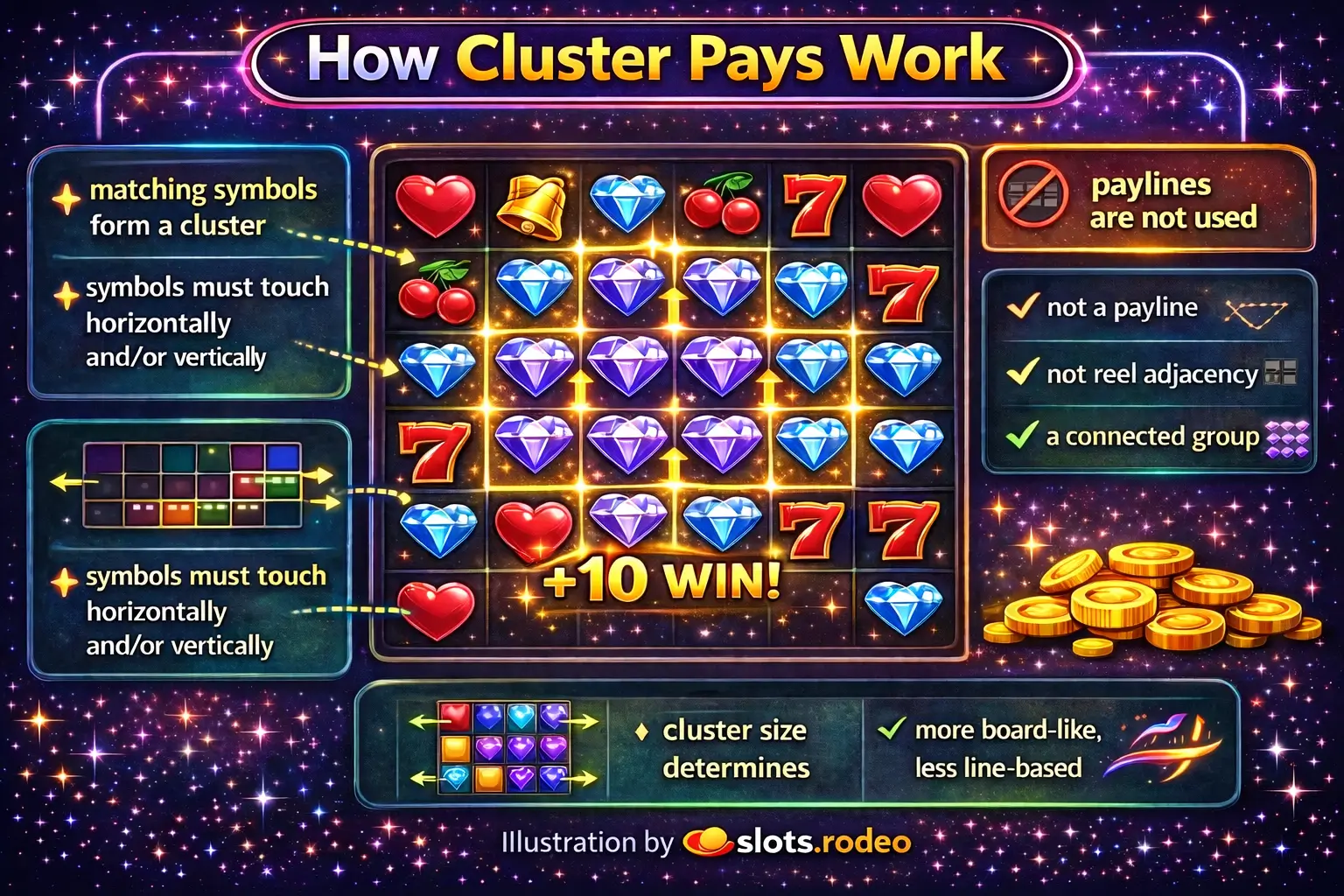
ALT:Illustration of a slot grid demonstrating how cluster pays utilize connected matching symbols rather than paylines
Caption:Cluster pays slots calculate wins based on connected symbol groups on a grid instead of along fixed paylines.
The formation of a cluster win
A cluster win typically requires aminimum quantity of matching symbolstouching one another. A typical guideline is that 5 or more adjacent symbols are required, though this can vary. Certain games may require 4, 6, or a different quantity.
The connection rule is more significant than the overall number of visible symbols. You could have numerous instances of the same symbol displayed, but if they are divided into distinct groups, they may not form any valid wins or only generate several smaller clusters.
Consequently, players should considerconnected formationsrather than just the total symbol count.
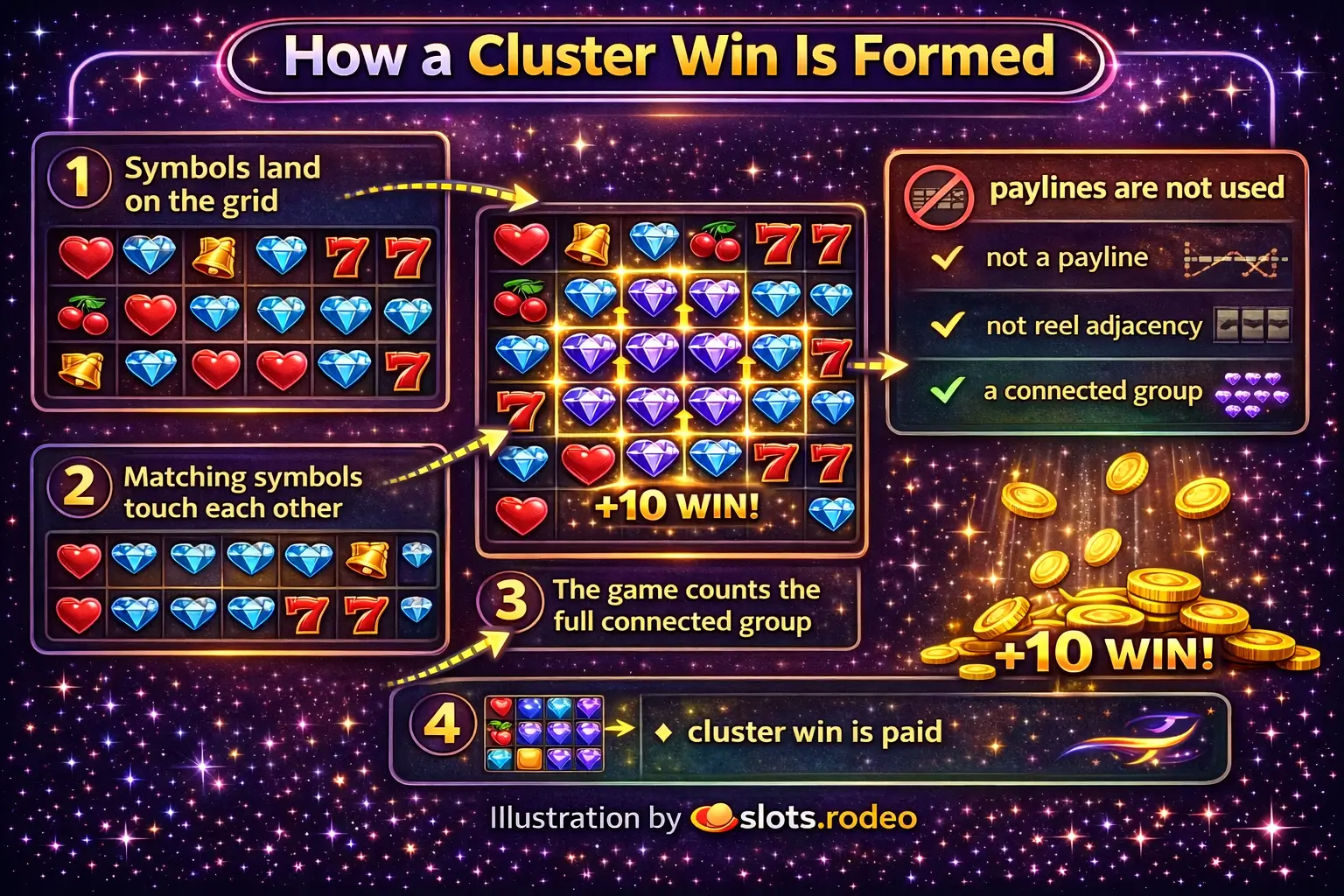
ALT:Diagram illustrating how a valid cluster win is achieved from adjacent matching symbols on a slot grid.
Caption:A cluster win relies on connected matching symbols, rather than the direction of lines or the order of reels.
The key rule: what qualifies as "connected"
This is the first aspect to confirm in any cluster pays slot.
In the majority of games, symbols are deemed connected when they are adjacent:
- horizontally
- vertically
Some games might permit diagonal connections as well, but this should not be taken for granted. This single rule can significantly affect the ease of cluster formation.
| Rule to check | Why it matters |
|---|---|
| Minimum cluster size | Tells you how many matching symbols are needed for a win |
| Type of connection | Shows whether only side-to-side contact counts or diagonal contact is included |
| Grid size | A larger grid can create more possible cluster shapes |
| Removal of symbols post-wins | Affects whether new symbols drop in and continue the sequence |
| Wild role | Some cluster games allow wilds to complete clusters |
| Multiplier dynamics | Some games apply growing multipliers during consecutive cascades |
Minimum cluster size
Type of connection
Grid size
Removal of symbols post-wins
Wild role
Behavior of Multipliers
Players who overlook the paytable may misinterpret the display. In a cluster slot, symbols might appear sufficiently close to yield a win, yet if they don’t adhere to the precise connection criteria, they will not be counted.
Rationale behind the association of cluster pays with cascading mechanics
Cluster pays andcascadesfrequently coexist as they adhere to similar screen dynamics.
A standard progression is as follows:
- a cluster is created
- the cluster rewards
- those winning symbols vanish
- new symbols descend into the vacant spots
- a new cluster may emerge
This is why many cluster slots resemble a chain reaction rather than a sequential line game. The mechanism relies ongrid replacementrather than a static reel stop outcome that concludes immediately after a single assessment.
However, not all cluster pays slots incorporate cascades, but the pairing is prevalent due to its natural fit with interconnected groups on a grid.
Comparing Cluster Pays with Paylines and Ways to Win
Cluster pays represent more than just a visual difference; they embody a distinct winning logic.
| System | What the game checks | Usual layout |
|---|---|---|
| Conventional paylines | Whether symbols land on preset line paths | Reel-based |
| Ways to win | Whether matching symbols appear on adjacent reels | Reel-based |
| Cluster pays | Whether matching symbols touch and form a connected group | Grid-based |
Standard paylines
Ways to win
Cluster payouts
This distinction impacts how players interpret the screen.
In a payline slot, the same symbols may appear but not yield payouts if they are misaligned.
In a ways-to-win slot, matching symbols can pay when they show on consecutive reels.
In a cluster pays slot, the order of reels generally holds less significance thanthe shape of the group and direct adjacency.
Why cluster games often appear more crowded
Cluster pays slots typically emphasize thewhole boardinstead of focusing on one reel strip individually.
This usually results in:
- square or nearly square layouts
- more symbol positions visible simultaneously
- chain reactions following wins
- expanding or altering symbol clusters
- mechanics that modify the board throughout the sequence
This can enhance readability for some players while diminishing it for others.
A novice familiar with classic slots might initially seek left-to-right patterns and overlook the actual rule. In cluster pays, the key inquiry is not "which line activated?" but rather "which connected cluster qualified?"
The function of cluster paysnottell you
The cluster pays mechanism clarifiesthe way wins are calculatedyet it does not provide information on:
- the game's volatility
- the frequency of cluster appearances
- the likelihood of cascading wins
- the strength of the bonus round
- the potential maximum win
Two slots utilizing cluster pays may share the same fundamental mechanics but can offer vastly different gameplay experiences. One might generate frequent minor wins, while another could rely on infrequent board-building scenarios and bonus features.
Thus, the format is significant, but it represents only one aspect of the overall game structure.
Frequent errors when interpreting a cluster pays slot
Counting isolated symbols as a single cluster
Players often notice numerous matching symbols and mistakenly think they all form a cluster. They only do so if they are connected as per the game's specifications.
Believing diagonals are always valid
Some games permit this, but many do not. This needs verification in the rules.
Confusing scatters with cluster symbols
Scatter symbols typically adhere to distinct triggering conditions and may not require connection.
Overlooking wild functionalities
In certain cluster pays slots, wilds assist in forming a cluster, while in others, their role may be limited or specific to certain features.
An effective method for quickly analyzing the board
Upon launching a cluster pays game, verify the following in sequence:
- the minimum cluster size
- if only horizontal and vertical connections are considered
- if diagonal connections are taken into account
- if winning combinations eliminate symbols from the game board
- if new symbols drop into place following symbol removal
- if multipliers or modifiers accumulate during cascading wins
This brief assessment provides more insight than simply labeling it as 'cluster pays.'
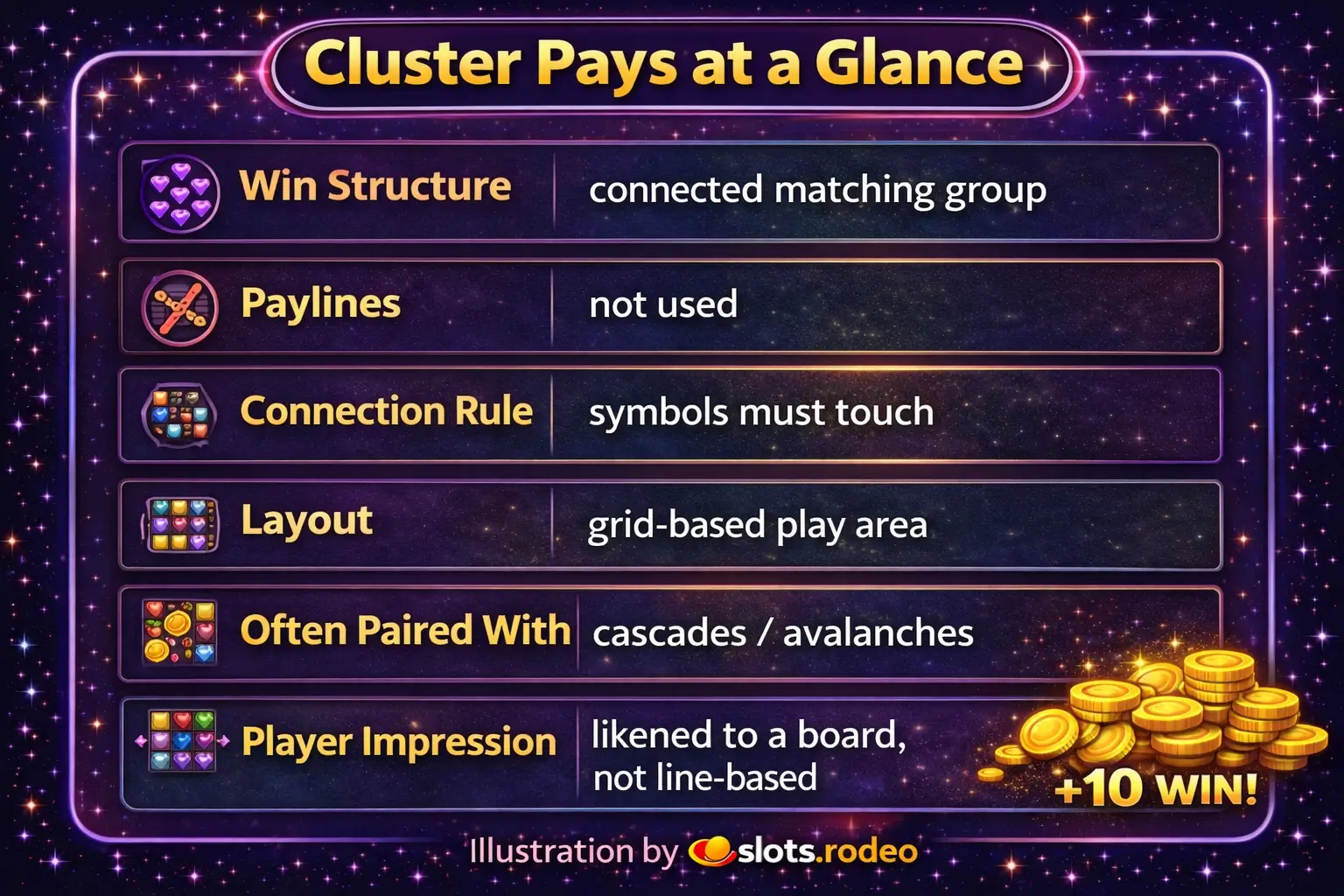
ALT:A graphic overview that encapsulates the essential rules and features of cluster pays slots
Caption:Cluster pays slots center around groups of matching symbols that are connected, typically arranged in grid formats and often involving cascades after wins.
The key areas where cluster pays has a significant impact
This structure is particularly important when the game incorporates features that alter the board after an initial win. Here, cluster pays transcends mere win-counting.
Notable examples include:
- cascades or avalanches
- symbol enhancements
- expanding clusters
- sticky modifiers on the playing field
- feature progression achieved through consecutive symbol removals
In such games, the cluster mechanism fosters a dynamic board that progresses throughout the sequence instead of resetting after each individual outcome.
FAQ
Frequently asked questions regarding this subject.
No. A cluster pays slot does not depend on fixed paylines. It typically awards payouts when sufficient matching symbols connect on the grid.
It varies by the game. Numerous titles require 5 or more connected symbols, but this number can change.
Occasionally, but not universally. It's necessary to consult the paytable or help section for the specific connection criteria.
No, but this combination is prevalent. Cluster pays naturally integrates with mechanics that involve symbol removal and substitution.
For some players, yes. For others, no. It hinges on whether they find connected groups more intuitive compared to traditional line-based winning paths.
