

A high RTP looks attractive on paper, but it does not tell you what will happen in the next 20, 50, or 200 spins.
That is one of the most common misunderstandings around slots. A player sees 96.5% RTP and expects a "better" short session than on a game with 95.5% RTP. In reality, both sessions can end in completely different ways, and the higher-RTP game can still produce a poor short-term result.
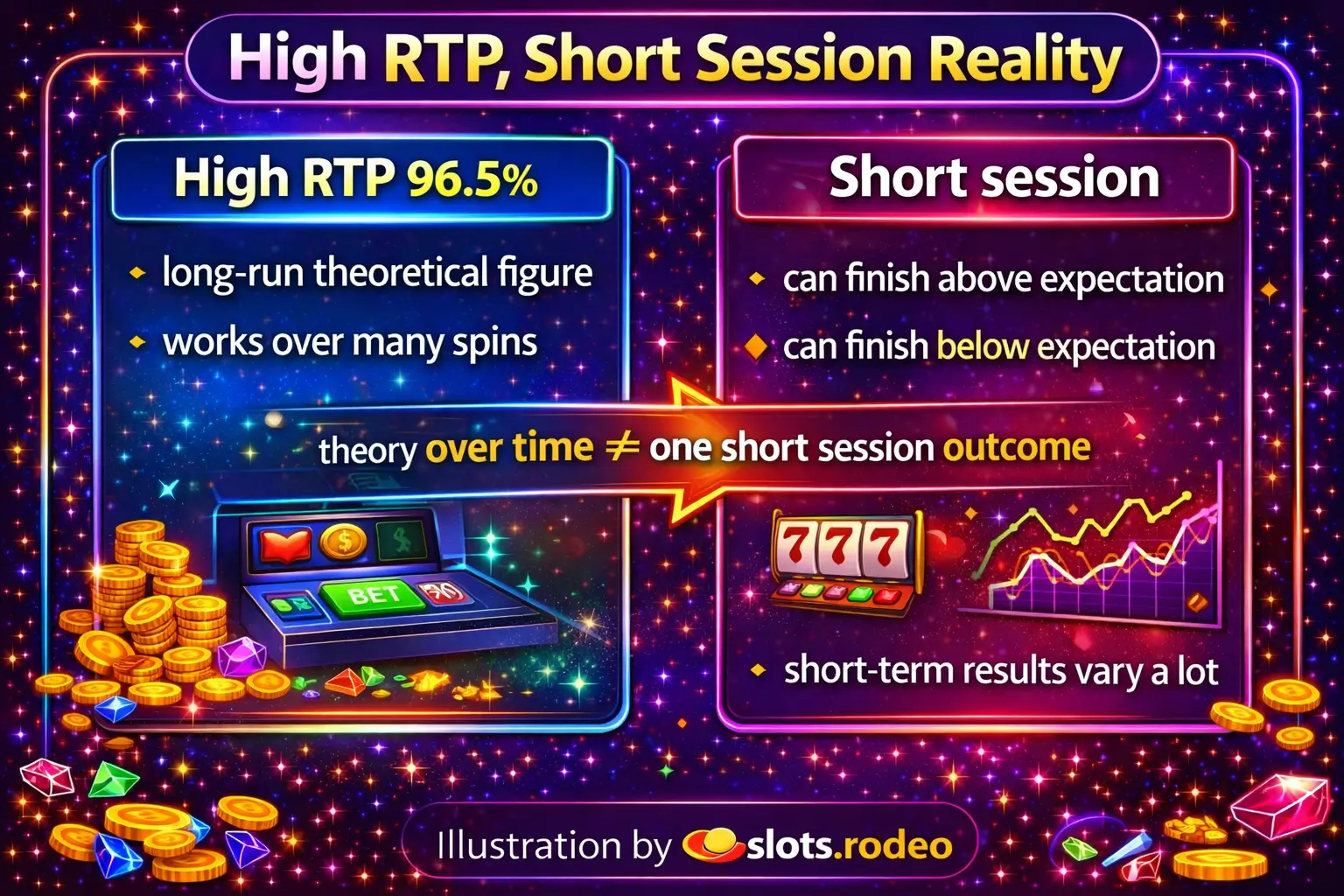
The reason is simple:RTP is a long-run theoretical average, not a short-session promise.
What RTP actually measures
RTP stands forReturn to Player. It is the theoretical share of total wagered money that a slot is expected to return over a very large number of spins.
If a game has 96% RTP, that doesnotmean:
- you get back 96 from every 100 you stake
- each session will stay close to 96%
- losses will be limited to 4% in normal play
- a short session will reflect the stated percentage
It means that across an extremely large sample, the game's payout model is built around that theoretical return.
Why short sessions can look nothing like the RTP figure
Short sessions are small samples. Small samples are noisy.
Slots do not return value in a flat, even line. Wins come in clusters, dry spells, bonus triggers, and occasional larger hits. Because of that, a session of 30 or 100 spins can land far above or far below the long-run number.
That is normal slot behavior, not a contradiction of RTP.
The main reason: variance inside a small sample
A slot's long-run average only becomes more meaningful as the number of spins grows. In short play windows, the result is heavily affected by timing.
For example, in one 80-spin session:
- the player may not reach any meaningful feature
- several wins may return less than the stake
- the balance may decline steadily
In another 80-spin session on the same game:
- an early bonus may trigger
- one stronger hit may change the whole outcome
- the final result may look much better than the RTP would suggest
Neither session "proves" the RTP right or wrong. They are just short-term samples inside a wider distribution.
A higher RTP does not remove volatility
This is where many players mix up two separate ideas.
- RTP= long-run theoretical return
- Volatility= how unevenly that return may show up
A slot can have high RTP and still feel harsh in short sessions if a lot of its value is concentrated in rarer events. Another slot with slightly lower RTP may feel steadier because more return is spread through smaller, more regular hits.
| Slot | RTP | Volatility | Possible short-session feel |
|---|---|---|---|
| Slot A | 96.4% | High | Longer dry stretches, stronger swings |
| Slot B | 95.8% | Medium | More regular activity, smoother balance path |
Slot A
RTP
96.4%
Volatility
High
Possible short-session feel
Longer dry stretches, stronger swings
Slot B
RTP
95.8%
Volatility
Medium
Possible short-session feel
More regular activity, smoother balance path
This doesnotmean Slot B is better in the long run. It means the short-session experience can feel more stable even with a slightly lower RTP.
Why short sessions can differ so much from theory
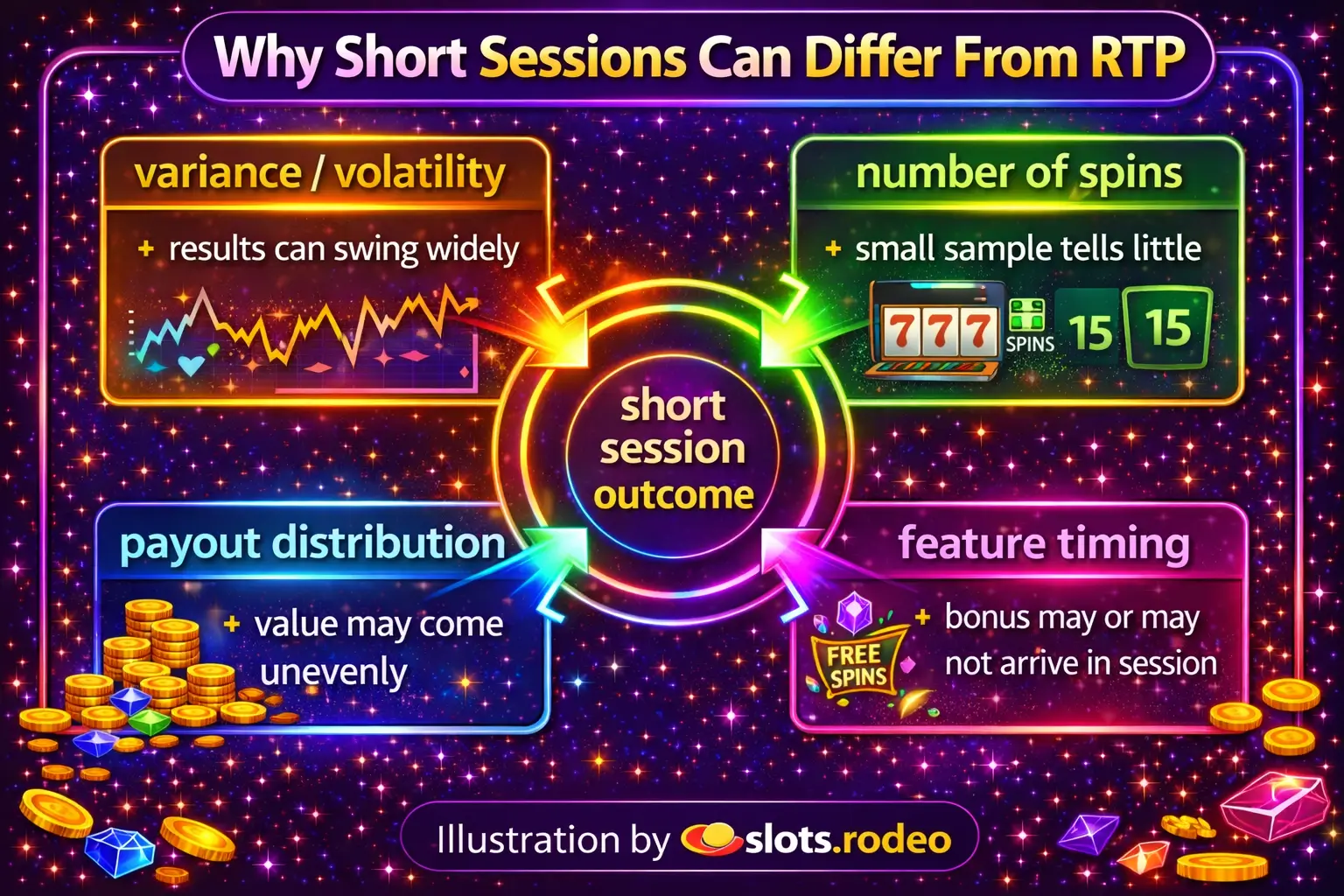
Several factors shape the gap between theory and actual short play.
Bonus timing
If a slot puts a large share of its return into free spins, respins, or feature rounds, a short session may depend heavily on whether that feature appears at all.
No feature in the session? The result may look much weaker than the stated RTP.
Payout distribution
Some games return value through many smaller wins. Others keep more value tied to less frequent, larger events.
The second type often creates wider short-term deviation.
Win size, not just win count
A slot may produce many "winning" spins that still return less than the total bet. That can make a session feel bad even when the hit rate looks active.
Session length
The shorter the session, the less meaningful RTP becomes as a practical guide to that exact outcome.
Two players can get opposite results on the same slot
This is one of the easiest ways to understand the issue.
Imagine the same slot with 96.2% RTP:
| Player | Session length | What happens | Short-term result |
|---|---|---|---|
| Player A | 60 spins | No bonus, several small losses | Weak session |
| Player B | 60 spins | Early bonus and one larger hit | Strong session |
Player A
Session length
60 spins
What happens
No bonus, several small losses
Short-term result
Weak session
Player B
Session length
60 spins
What happens
Early bonus and one larger hit
Short-term result
Strong session
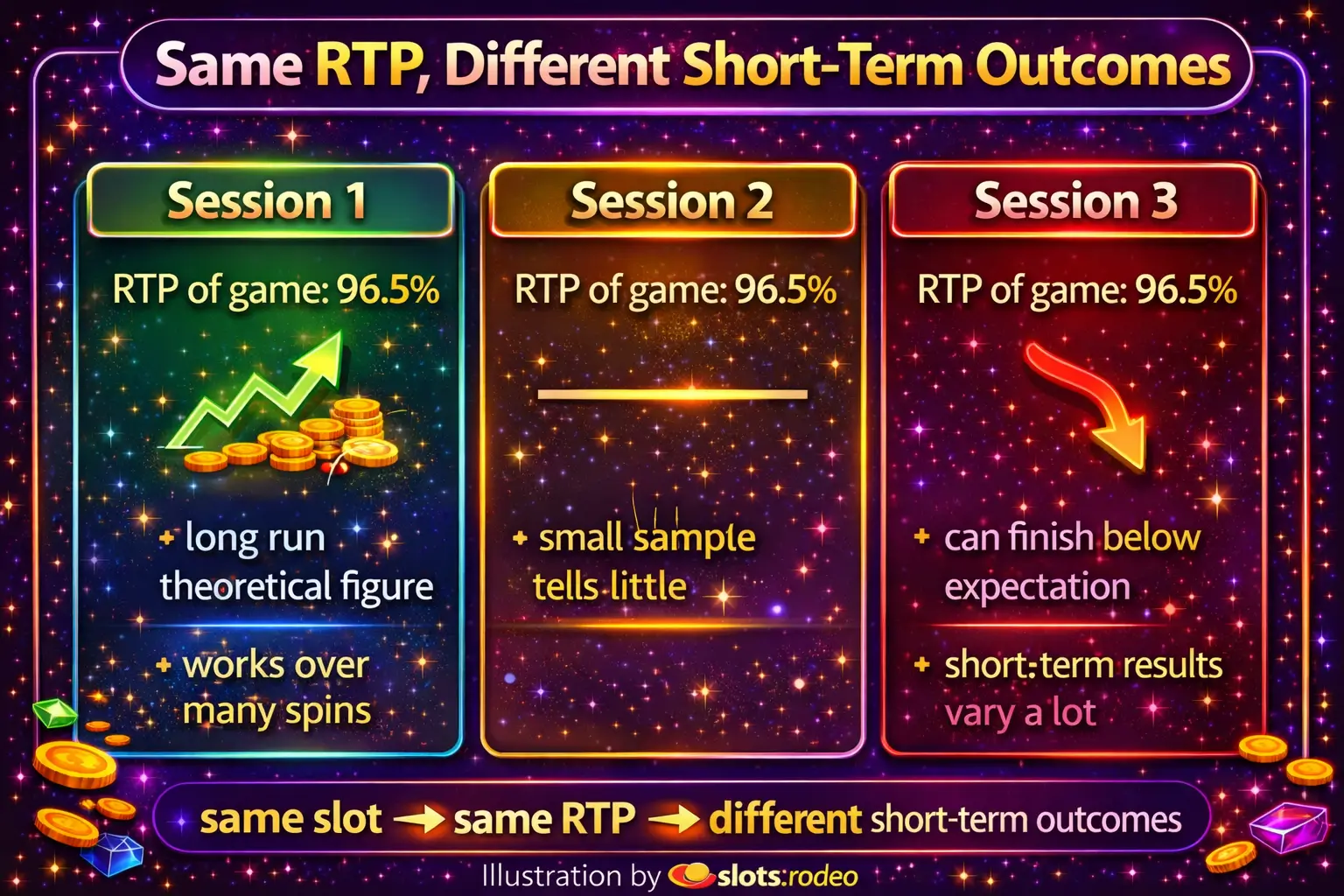
Identical game and RTP, yet the short-term outcomes can vary significantly.
This illustrates why RTP should not be considered a predictor for session results.
The significance of a 1% RTP disparity may be less impactful in a short session than players might assume.
In the long term, variations in RTP are important. A slot with 96.5% RTP is theoretically superior to one at 95.5%, assuming all other factors are equal.
However, during a brief session, this difference can be overshadowed by typical volatility.
A player could experience rapid losses on the higher-RTP slot while faring better on the lower-RTP option in the same night. This does not render RTP irrelevant; it highlights that short-term variance can be more pronounced than expected.
The practical applications of high RTP and its limitations.
High RTP becomes valuable when comparingtheoretical long-term returnsacross different slots or varying RTP versions of a single game.
It does not serve as a guarantee for:
- a more secure short session
- smoother balance fluctuations
- faster bonus triggers
- reduced periods of losses
- immediate "better value" within a limited number of spins.
Thus, RTP should be evaluated alongside additional factors.
Other considerations beyond RTP
For a clearer understanding of a slot's experience during short play, RTP on its own is insufficient.
| What to check | Why it matters |
|---|---|
| Volatility | Helps explain how wide short-term swings may be |
| Bonus mechanics | Shows whether much of the return depends on features |
| Base-game engagement | Indicates whether the session may feel active between bonuses |
| Maximum win potential | Suggests whether the slot leaves room for more top-heavy outcomes |
| Game regulations | Best source for the game's own stated setup |
Volatility
Importance of these factors
They help clarify the extent of short-term fluctuations.
Bonus mechanics
Importance of these factors
Indicates if the returns are heavily reliant on bonus features.
Base-game engagement
Importance of these factors
Suggests whether gameplay remains dynamic between bonus rounds.
Maximum win potential
Importance of these factors
Indicates if the slot allows for more significant high payout scenarios.
Gameplay guidelines
Importance of these guidelines
Most reliable source for the game's declared parameters
This provides a more accurate representation of session trends compared to RTP alone.
A straightforward perspective
RTP addresses this inquiry:
What is the theoretical return the game is designed to provide over a significantly large sample?
Brief play sessions pose a different query:
How will this specific segment of gameplay perform before the long-term average has an opportunity to manifest?
These inquiries are not identical.
The relevance of RTP
RTP continues to be significant as it is one of the most transparent indicators of theoretical long-term value.
If two iterations of the same slot are the same, but one features a higher RTP, the version with the greater RTP is typically the superior mathematical choice over time.
However, that long-term advantage does not shield a short session from typical variance.
FAQ
Frequently asked questions regarding this matter.
No, while a high RTP enhances theoretical long-term returns, a brief session can still end unfavorably.
Yes, in short gameplay, variance can easily surpass a minor RTP variation.
This is due to RTP not guaranteeing outcomes in subsequent sessions. Brief samples can significantly fall short of the long-term average.
No, while it is beneficial for long-term evaluations and assessing game worth, it should not be interpreted as a prediction for a session.
Factors such as volatility, payout distribution, timing of features, and reliance on bonuses often influence the short-session experience more directly than RTP by itself.
