

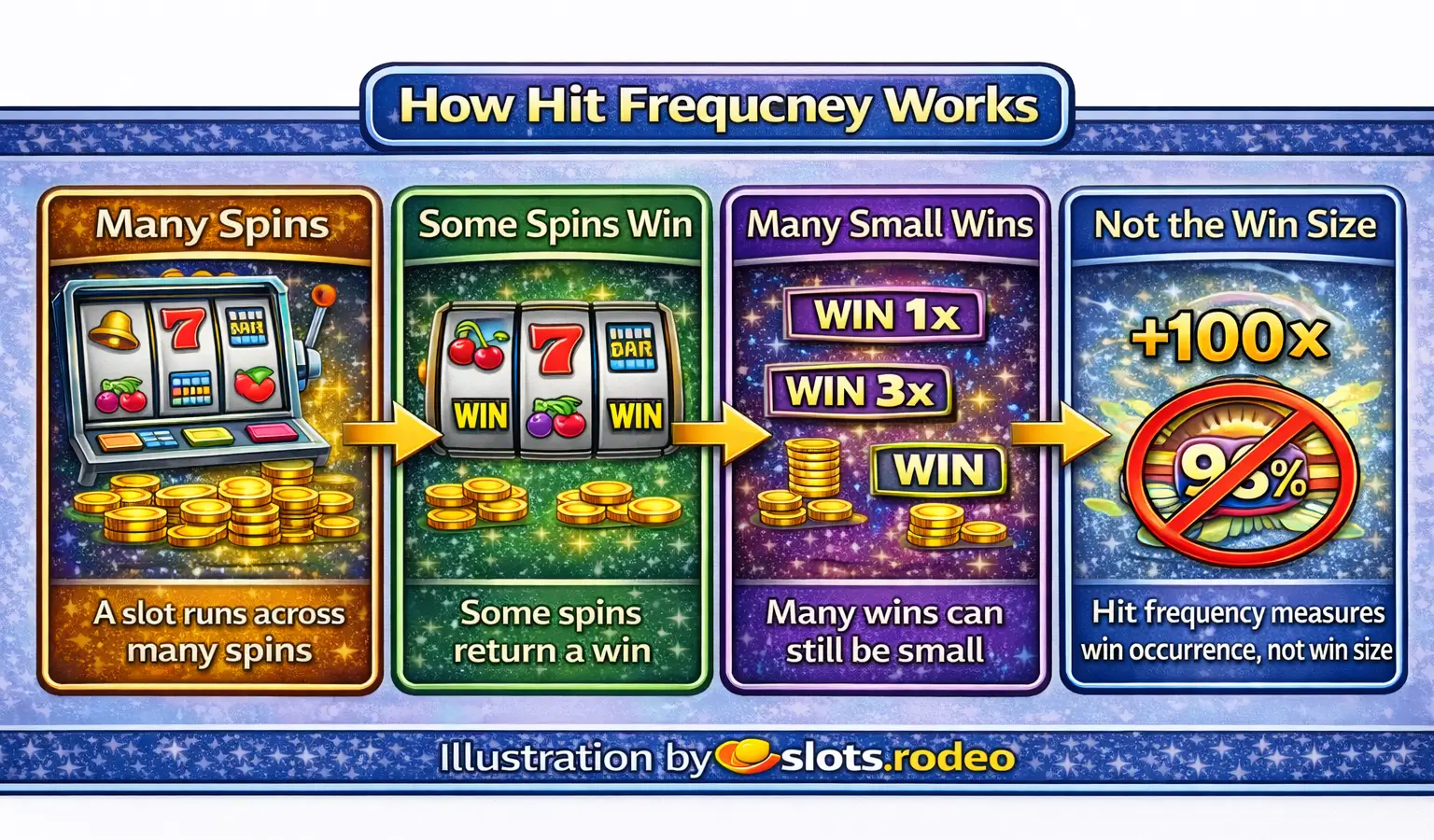
Hit frequency in slots refers to the frequency at which a game results in a win.
In straightforward terms, it responds to this inquiry:
How often does the slot yield any form of win?
A slot with a higher hit frequency typically generates winning spins more regularly. Conversely, a lower hit frequency indicates that wins are less frequent.
While this seems straightforward, many players misinterpret the implications of hit frequency. A slot that frequently pays does not necessarily offer substantial payouts, and a slot that pays less frequently is not inherently inferior. Hit frequency indicatesthe occurrence rate of winsbut not the magnitude or significance of those wins.
Practical implications of hit frequency
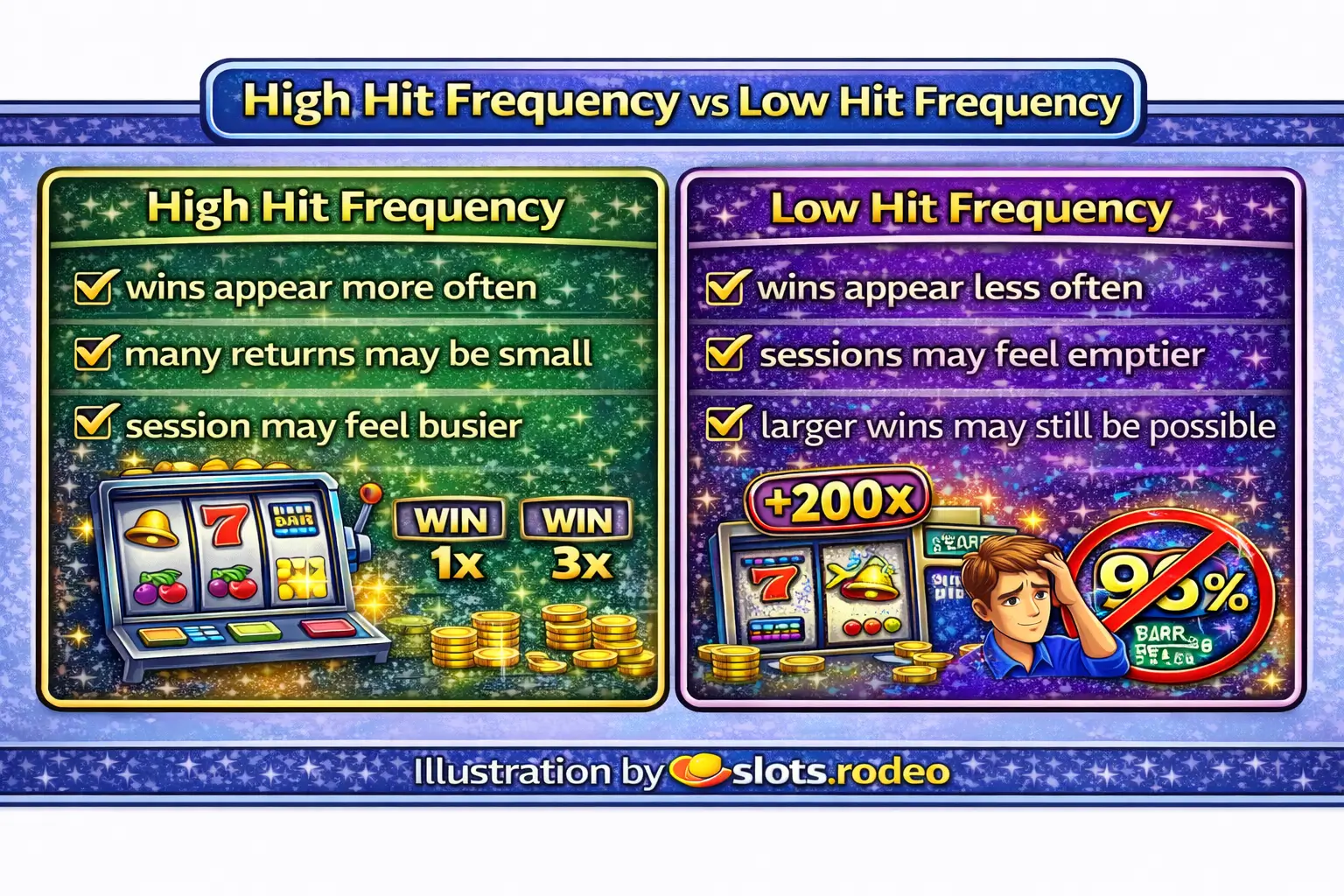
If a slot has a comparatively high hit frequency, you might experience:
- more regular small payouts
- fewer extended periods without wins
- a more dynamic session experience
- more spins that generate some return, albeit small
In contrast, if a slot has a relatively low hit frequency, you might encounter:
- more consecutive losing spins
- less frequent winning outcomes
- a more subdued or challenging session experience
- greater value concentrated in fewer wins
The essential term here issession experience. Hit frequency significantly influences the feel of a slot during gameplay, even if it does not entirely clarify the long-term statistical outcomes.
Hit frequency pertains to the occurrence of wins, not their size
This distinction is crucial.
A slot can exhibit:
- high hit frequency with numerous small wins
- low hit frequency with fewer but larger wins
- moderate hit frequency with a varied payout structure
Thus, when players claim "this slot has frequent hits," they generally mean it tends to return something more often. However, that doesnotnot guarantee that those wins are substantial enough to cover losses.
For instance:
| Slot profile | What it may look like |
|---|---|
| Frequent wins | Many small wins, frequent activity |
| Infrequent wins | Fewer wins, more empty spins |
| Comparable RTP, varying hit frequency | Same long-term return, very different session feel |
Frequent wins
Infrequent wins
Comparable RTP, varying hit frequency
This illustrates why hit frequency should not be equated with profitability.
Understanding hit frequency
A slot machine offers various potential outcomes for each spin.
Some of these outcomes include:
- non-winning outcomes
- small wins
- medium wins
- feature activations
- larger wins
Hit frequency centers on a fundamental inquiry:
What proportion of spins results in any wins?
A slot may exhibit a high hit frequency if it frequently generates small line wins, mini cluster payouts, or low-value returns. Conversely, if it yields fewer winning outcomes overall, its hit frequency might be lower.
This is a general idea, although different providers may calculate or present it in various ways.
A 'hit' does not always signify a winning spin
This is a common point of confusion for newcomers.
A winning spin does not always equate to agoodpositive balance outcome.
Example:
- total wager = $1.00
- winning spin yields $0.20
This is technically a hit since it resulted in a win. However, it still represents a net loss for that spin.
Thus, a slot can produce frequent hits while continuously depleting the balance over time.
This is a crucial practical aspect of hit frequency.
High hit frequency compared to low hit frequency
The simplest way to grasp hit frequency is through comparison.
| Feature | High hit frequency | Low hit frequency |
|---|---|---|
| Winning spins | More common | Less common |
| Losing streaks | Usually shorter | Usually longer |
| Minor payouts | More frequent | Less frequent |
| Session dynamics | More active | More uneven or dry |
| Concentration of value | Often spread more widely | Often more concentrated |
Winning rounds
Streaks of losses
Minor payouts
Session dynamics
Concentration of value
Hit frequency differs from RTP
A slot could display a high hit frequency alongside an average RTP, or conversely, a low hit frequency while maintaining the same RTP.
This distinction exists because RTP and hit frequency represent different metrics.
RTP
RTP refers to a theoretical percentage of returns over the long term.
Hit frequency
Hit frequency pertains to the regularity of winning results.
A slot that frequently pays out smaller amounts might still yield the same theoretical percentage as one that pays out less often but in larger sums.
Thus, when evaluating slots, RTP and hit frequency should not be seen as equivalent.
Hit frequency is distinct from volatility
While these two concepts are connected in terms of the experience a slot provides, they are not the same.
Slots that exhibit a lower hit frequency typically feel more volatile, as they may have more spins without wins between significant events.
Conversely, a higher hit frequency is often found in slots that provide a smoother experience due to the more frequent occurrence of smaller wins.
However, this should not be viewed as a definitive rule.
A slot can:
- frequently provide payouts but still retain most of their value for occasional larger features
- offer lower payouts but may not exhibit extreme overall volatility
- mix moderate hit frequency with significant bonus-driven fluctuations
Thus, while hit frequency can shape the overall session experience, it does not solely determine the complete volatility profile.
The significance of hit frequency for players
Hit frequency is important as it influences the immediate experience of a slot during play.
It can impact:
- the frequency of wins displayed on the screen
- the perception of how long dry spells last
- the perceived level of activity in the base game
- whether the slot feels dynamic or stagnant
- the speed at which the session may become frustrating
For numerous players, this becomes more apparent than RTP during actual gameplay. The rhythm of wins can be felt much more quickly than long-term returns can be assessed.
A high hit frequency does not imply low risk
This is a prevalent misconception.
A slot that delivers frequent small wins can still carry risk because:
- many wins might fall below the total wager amount
- accessing feature value could still prove challenging
- the balance might continue to decline gradually
- larger wins may still be infrequent
A slot that 'hits frequently' may merely return small portions of the stake more consistently.
While this may create a smoother experience, it does not inherently make the game mathematically safer.
A low hit frequency does not indicate a poor slot
Slots with lower hit frequencies may simply allocate value in a different manner.
Possible explanations include:
- greater focus on bonus features
- higher average win amounts when wins do occur
- longer intervals between significant events
- higher concentration of returns in premium combinations
Thus, a slot with a lower hit frequency is not necessarily inferior. It typically just means that wins appear less frequently on screen.
Hit frequency can encompass a variety of win types.
Not all wins hold the same significance.
In various slots, a winning spin can be:
- a minimal line win
- a nearly break-even payout
- a scatter win
- a cluster payout
- a trigger for a bonus feature
- a higher multiplier gain
While all these are classified as wins, their impact on the player varies considerably.
This is why hit frequency alone offers a limited perspective.
A straightforward illustration of hit frequency in action
Consider two different slots:
Slot A
- frequent wins occur
- many payouts range from 0.2x to 0.8x the wager
- bonus activations are less pivotal to the overall gaming experience
Slot B
- wins are less frequent
- streaks of losses tend to be more prolonged
- some wins provide greater rewards when they occur
- more potential value may be found within the feature
Both slots can be well-designed; they simply offer different gameplay dynamics.
This illustrates the real-world implication of hit frequency.
Reasons why providers may not clearly emphasize hit frequency
Unlike RTP, hit frequency may not be presented in a consistent format across different slots.
Some explanations include:
- not every game information screen includes it
- various sources might interpret it differently
- players frequently mix it up with volatility or payout percentage
- the figure itself can be deceptive without proper context
Consequently, hit frequency is typically regarded more as a feature of gameplay than as a primary metric published.
Frequent misconceptions about hit frequency among players
Considering every hit a favorable outcome
A hit might still fall below the total wager amount.
Mistaking hit frequency for RTP
One indicates how often wins occur; the other reflects the long-term expected return.
Confounding hit frequency with volatility.
While they can be interconnected, they are distinct concepts.
Believing that high hit frequency equates to greater value
Regular wins do not necessarily translate to higher returns.
Assuming a low hit frequency indicates a poor slot
Certain slots may simply allocate value across fewer occurrences.
What hit frequency fails to reveal
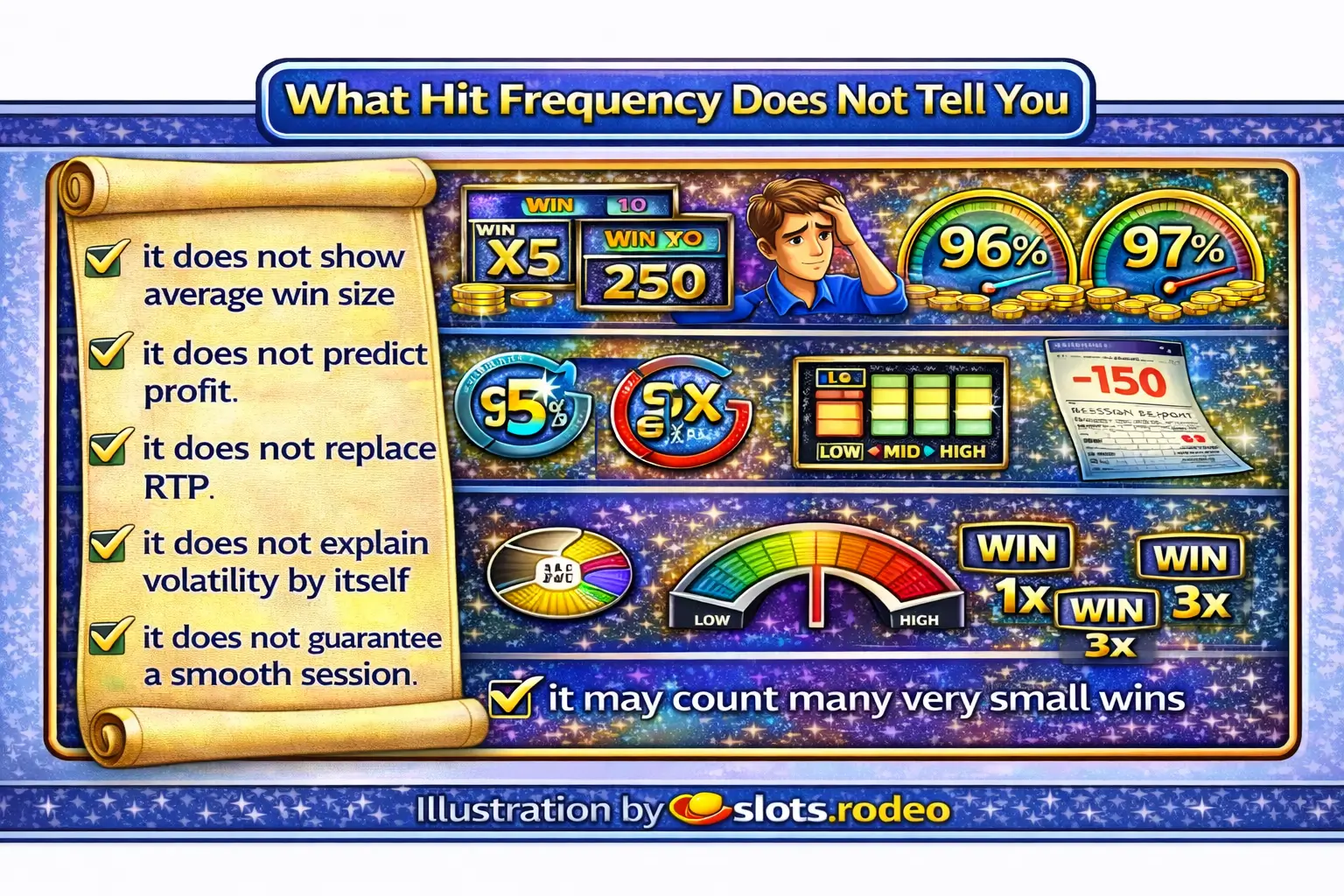
Hit frequency provides insight, but has its limitations.
It doesnottell you:
- the magnitude of the average win
- whether the majority of wins fall below or exceed the stake
- the proportion of the slot's RTP associated with the bonus round
- the frequency of triggering free spins
- the overall volatility of the game
- the maximum potential win
- if the slot is profitable over a short play session
How to interpret hit frequency accurately
The optimal approach to understanding hit frequency is as asession rhythm metric.
It can aid in determining:
- if the slot generally generates frequent visible wins
- if dry periods might seem prolonged
- if the game consistently offers small payouts
- if the gameplay appears more fluid or more abrupt
When used this way, hit frequency proves beneficial.
When simplified to mean "good slot" or "bad slot," it can be misleading.
A brief overview: what hit frequency can and cannot indicate
| Useful for | Not enough for |
|---|---|
| Grasping how frequently wins occur | Predicting long-term return |
| Assessing session experience | Measuring volatility alone |
| Understanding why one slot seems more engaging | Estimating average win size |
| Recognizing designs that feature frequent small wins | Judging full game value by itself |
Grasping how frequently wins occur
Assessing session experience
Discussing why a particular slot may seem more dynamic
Spotting designs that yield frequent smaller wins
FAQ
Frequently asked questions regarding this subject.
It indicates the frequency at which the slot generates winning outcomes.
No. It typically suggests that wins occur more regularly, not that they are of higher value.
Yes. A high number of wins can still total less than the original bet.
No. RTP reflects long-term expected returns, while hit frequency denotes the rate of winning events.
No. It often indicates a slot that offers fewer wins, consolidating value into select outcomes.
