

Variance is a key factor that can lead to significantly different bankroll impacts between two slots, even if their RTP values appear comparable.
A session's outcome is influenced not just by the long-term return figure, but also bythe irregularity of that return's distribution. Some slots provide value more consistently, while others focus value in infrequent events, resulting in more significant swings and heightened pressure on the bankroll during key wins.
This is why variance is crucial for assessing session risk.
Understanding Variance in Simple Terms
In the context of slot gaming, variance refers to how much results can deviate from the average outcome.
A slot with lower variance typically offers more consistent, smaller returns, whereas a higher-variance slot tends to provide more substantial rewards but less frequently.
This doesnotThis does not imply that low variance is inherently 'safe' or that high variance is 'problematic.' It indicates that different slot types can produce distinct balance behaviors.
The Greater Importance of Variance in Actual Sessions Compared to Theory
Most players engage with a slot over a limited sample size, unlike the large samples that inform the RTP figure. Their experience is shaped by one evening, a single bankroll, a defined session duration, and one bonus cycle.
In real-life scenarios, the effects of variance can be more pronounced than the theoretical long-term averages suggest.
While a lower-variance slot might still incur losses, the loss trajectory can be more gradual. Conversely, a higher-variance slot may exert more pressure on the bankroll due to longer periods of inactivity before a significant win occurs.
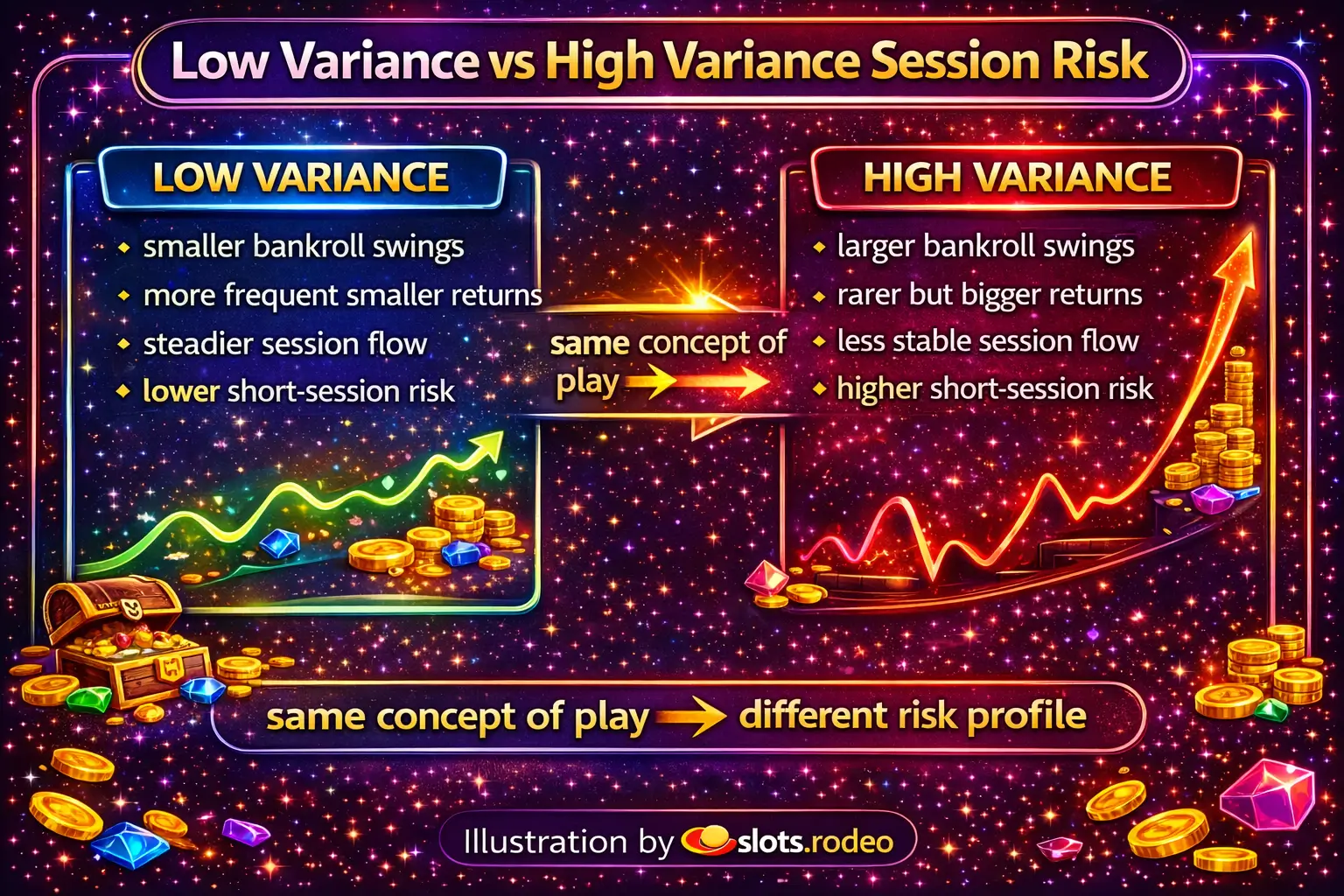
Low variance and high variance slots do not affect bankroll management in the same manner.
The clearest way to assess session risk is to examine how the bankroll typically behaves.
| Slot type | Typical bankroll movement | Common session feel | Risk profile |
|---|---|---|---|
| Low Variance | Smaller fluctuations | More stable, more regular activity | Lower short-term swing risk |
| Medium Variance | Mixed movement | Alternates between quiet and active phases | Moderate swing risk |
| High Variance | Larger drops and sharper jumps | Longer waiting periods, stronger turns | Higher short-term swing risk |
Low Variance
Medium Variance
High volatility
This table outlines a general trend, not a guarantee for any particular gaming session.
Impact of variance on bankroll throughout a session
Variance influences the degree of pressure the bankroll experiences before the slot delivers substantial returns.
A lower-variance slot may help maintain the balance with more frequent minor wins. While these payouts may not yield profit, they can mitigate losses and soften the session's intensity.
Conversely, a higher-variance slot typically operates differently:
- more spins might yield no returns
- many wins could be insufficient to balance out the expenses
- more significant wins may occur less often
- a single bonus round might account for a major portion of the session's value
Consequently, the balance could decrease more rapidly between favorable outcomes.

The reason high volatility often correlates with increased bonus reliance
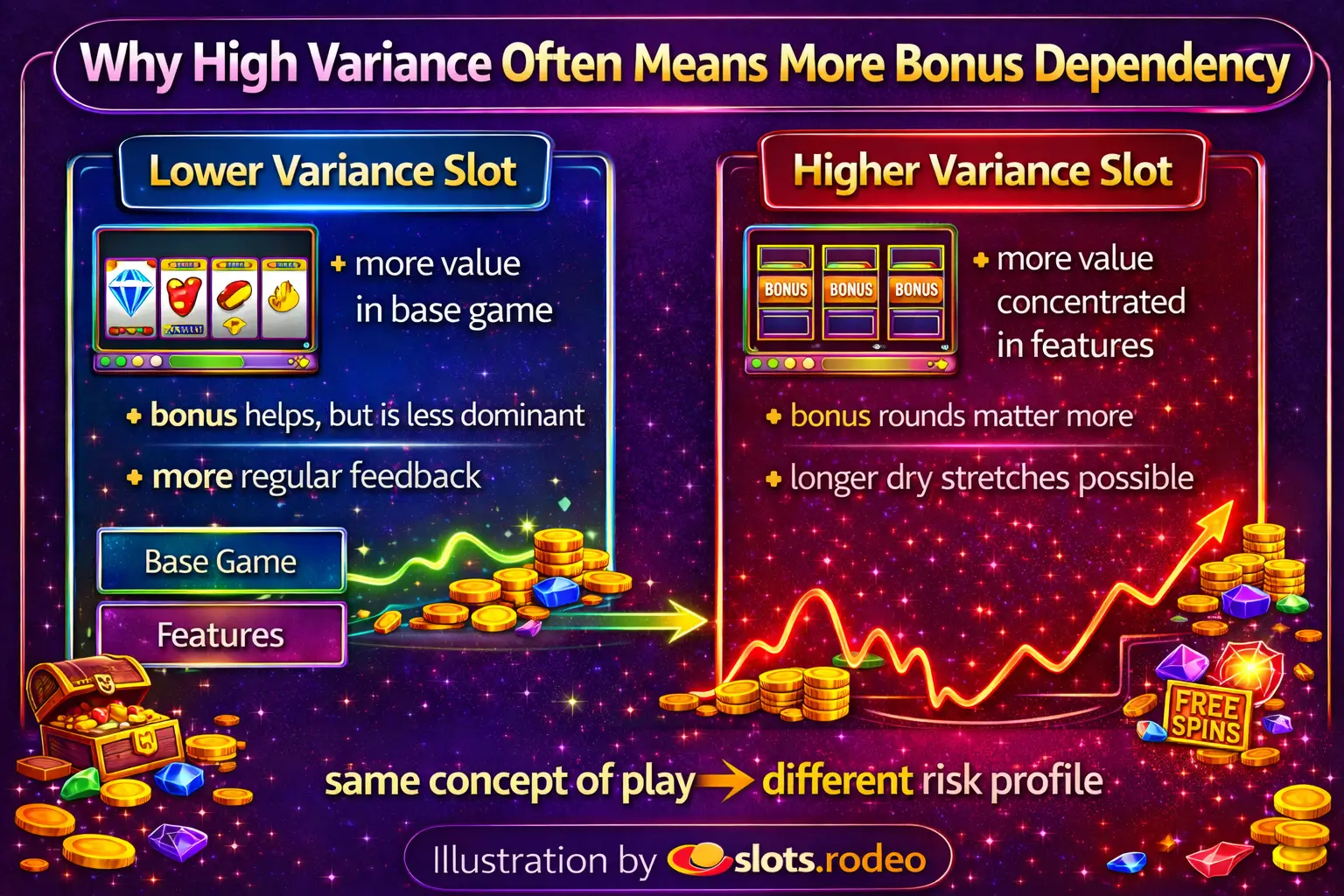
High-variance slots typically allocate a greater portion of their returns to bonus rounds, unique features, multipliers, or premium combinations.
This leads tobonus reliance. Simply put, the session becomes more dependent on activating a feature that can hold significant value.
This does not imply that all high-variance slots function identically, but the trend is prevalent:
- base game may experience extended periods of inactivity
- smaller base-game wins might not effectively maintain the balance
- the bonus emerges as a key event rather than a secondary feature
- failing to trigger the bonus can swiftly diminish the session's appeal
This is why high volatility can seem more severe during brief play.
Session consistency relies on more than just RTP
A player might observe two slots with comparable RTP and presume they entail similar session risks. This assumption is frequently inaccurate.
Variance alters theshapeof the gaming session.
| Factor | Lower-variance slot | Higher-variance slot |
|---|---|---|
| Rate of favorable returns | More common | Less common |
| Dependence on bonus features | Lower | Higher |
| Pressure from dry spells | Usually lower | Usually higher |
| Distribution of short-term results | Narrower | Wider |
| Stability of the session | More stable | Less stable |
Rate of favorable returns
Dependence on bonus features
Pressure from dry spells
Distribution of short-term results
Stability of the session
This is why session stability cannot be assessed solely by RTP.
An identical RTP can indicate vastly different session risks
Consider two slot games:
| Slot | RTP | Variance | Likely session pattern |
|---|---|---|---|
| Slot A | 96.1% | Low-medium | More regular returns, softer swings |
| Slot B | 96.0% | High | Longer dead stretches, stronger dependency on bonus timing |
Slot A
Slot B
The RTP variance is minimal. The difference in session risk can be considerably more apparent.
This is due to variance influencing the distribution of returns throughout the session, rather than just the game's long-term return potential.
Why high variance can feel harsher in brief sessions
Brief gaming sessions enhance the impact of high variance.
A player faces constraints on spins, bankroll, and time to 'wait' for the events that define the value of the slot. Should those events not materialize promptly, the session might conclude long before the long-term probabilities can manifest.
This leads to three significant challenges:
1. Increased pressure on the bankroll
The bankroll may diminish rapidly before a substantial win occurs.
2. Greater reliance on timing
A powerful feature can save the session, but only if it triggers within the actual gameplay period.
3. Broader emotional and financial fluctuations
Outcomes may seem more drastic from one gaming session to the next.
Low variance does not equate to minimal loss
It's crucial not to misinterpret the label.
A slot with lower variance can still lead to a losing session; it merely tends to offer results in a less volatile manner. In other terms, while the journey may be steadier, the outcome can still be unfavorable.
Variance pertains tothe movement of the sessionnot the overall winning status of the player.
What to evaluate if session risk is a concern
If you prioritize session stability, consider factors beyond just the RTP figure.
| What to check | Why it matters for risk |
|---|---|
| Volatility / variance classification | Gives the clearest clue about swing intensity |
| Bonus mechanisms | Shows how much value may depend on feature access |
| Base-game performance | Helps indicate whether the game supports the balance between bonuses |
| Max win context | Very large top-end potential often comes with wider payout spread |
| Game rules and paytable | Best place to verify how the slot is presented by the game itself |
Volatility / variance classification
Bonus mechanisms
Base-game performance
Max win context
Game rules and paytable
These evaluations do not guarantee a specific outcome, but they provide a clearer understanding of actual session risk.
An illustrative practical example
Consider variance in this way:
- Lower variance:the game tends to return value in smaller amounts more frequently
- Higher variance:the game may retain value for longer periods and return larger amounts during less frequent occurrences
Both slot games can feature a strong RTP on paper. The distinction lies in the level of stress the bankroll may endure before that value manifests.
When high variance might benefit a player - and when it might not
A high-variance slot could be appropriate for a player who embraces significant short-term fluctuations and recognizes that much of the value may be tied to infrequent occurrences.
It might be less fitting for a player who prefers:
- more consistent balance fluctuations
- reduced reliance on bonuses
- fewer drastic losses during brief sessions
- a less volatile session experience
This is not about labeling slots as "good" or "bad". It focuses on aligning the slot's characteristics with the player's comfort level for session risk.
FAQ
Frequently asked questions on this subject.
No. RTP represents the theoretical long-term return. Variance indicates how inconsistently that return may materialize during actual gameplay.
Because they often depend more on rare occurrences and exert more strain on the bankroll in between those instances.
No. Any slot can lead to an unfavorable session. Lower variance typically results in less dramatic swings, not guaranteed safety.
This is due to a larger portion of the total return often being concentrated in bonus rounds or other less frequent premium events.
Variance typically has a more pronounced impact on short-session risk, while RTP serves as a theoretical measure over the long term.
