

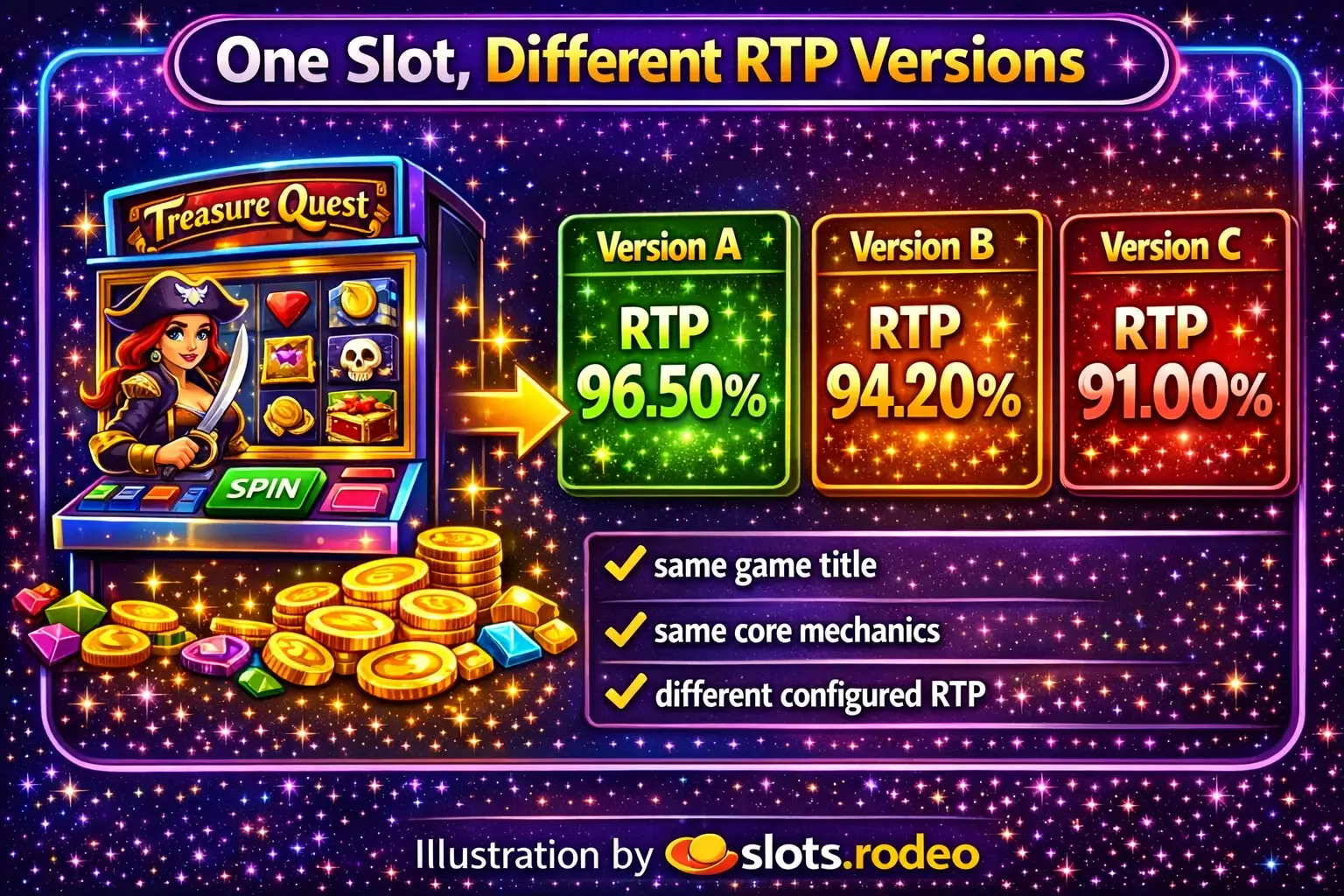
A slot title is not necessarily linked to a single fixed RTP. Often, the same game is made available in multiple RTP configurations. While the design, reels, symbols, bonus features, and maximum win can remain unchanged, the theoretical return can vary.
This is significant because two online casinos might provide the same slot, but the long-term expected return could differ. If a player only compares the game title, their assessment might be inadequate.
Reasons a slot can have multiple RTP versions
RTP representsReturn to Player. This is the theoretical percentage of total wagers that a game is expected to pay back over a substantial number of spins.
A game developer may create several RTP settings for a single slot. For instance, one version could be configured at 96.20%, while another might be set to 94.10%, and yet another at 91.00%. Players typically see the same brand, artwork, and generally the same features, but the core payout structure varies.
This approach allows the same game to be offered to various operators, markets, or business models.
What typically remains constant, and what varies
Multiple RTP versions donotnot typically imply that the entire slot is recreated from the ground up. In most instances, the visible aspects are nearly indistinguishable.
| Part of the slot | Usually stays the same | Can change between RTP versions |
|---|---|---|
| Game title | Yes | No |
| Theme and visuals | Yes | Rarely |
| Reel layout | Yes | Usually no |
| Bonus features | Yes | Usually no |
| Paytable amounts | Sometimes | Sometimes |
| Underlying payout structure | No | Yes |
| Expected long-term return | No | Yes |
Game title
Theme and visuals
Reel layout
Bonus features
Paytable amounts
Underlying payout structure
Expected return over the long term
In reality, players might find what seems like the same slot at two different casinos, experiencing similar gameplay, but the underlying theoretical return can vary.
The role of providers and casinos
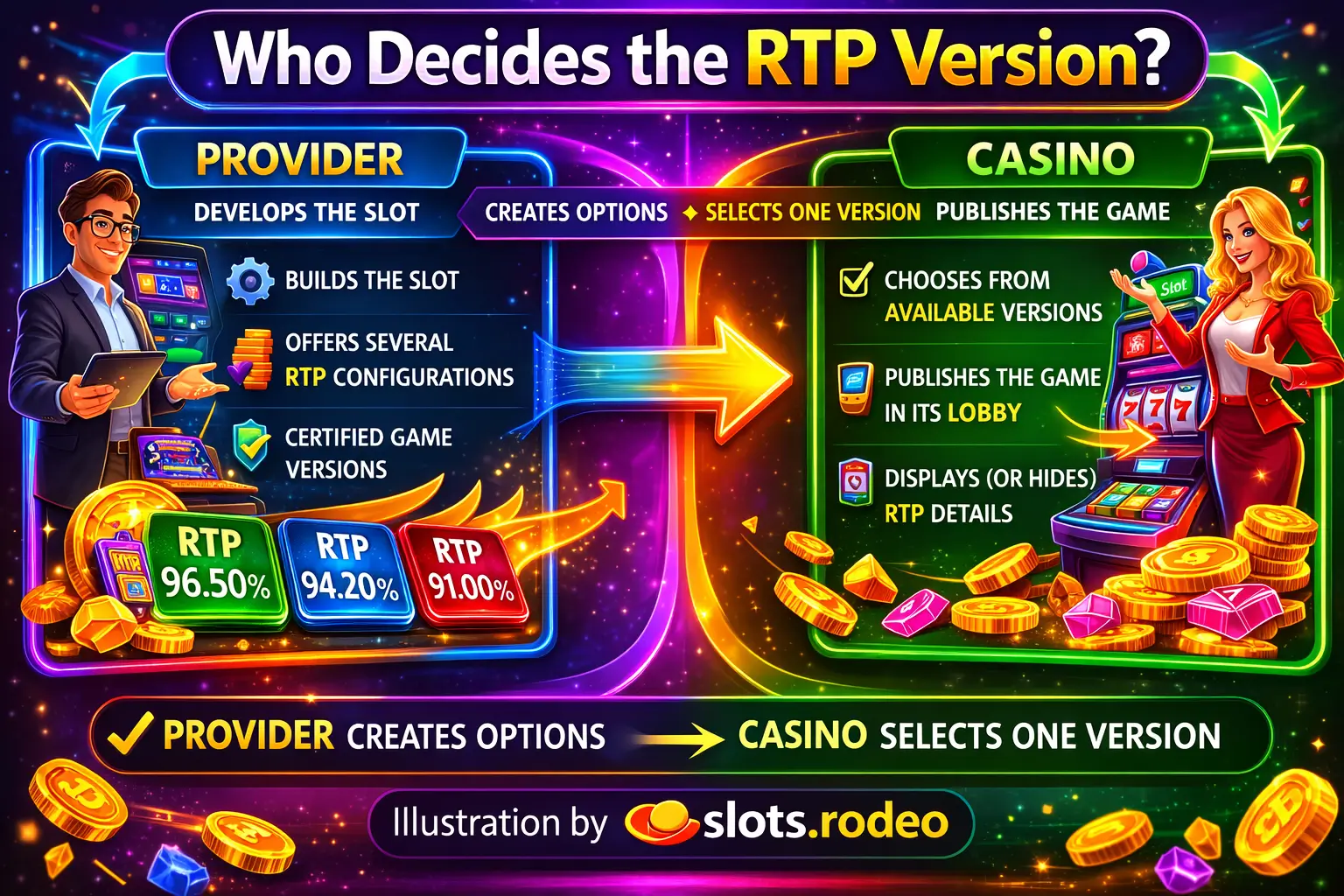
The game developer usually designs the slot and provides one or several RTP variants. The casino operator can then select from the available versions for that game based on its platform, licensing, or market agreements.
This doesnotimplies that a casino cannot arbitrarily set any RTP it desires for any slot. The options are typically confined to those versions created and supported by the provider or platform.
The significance in comparing casinos
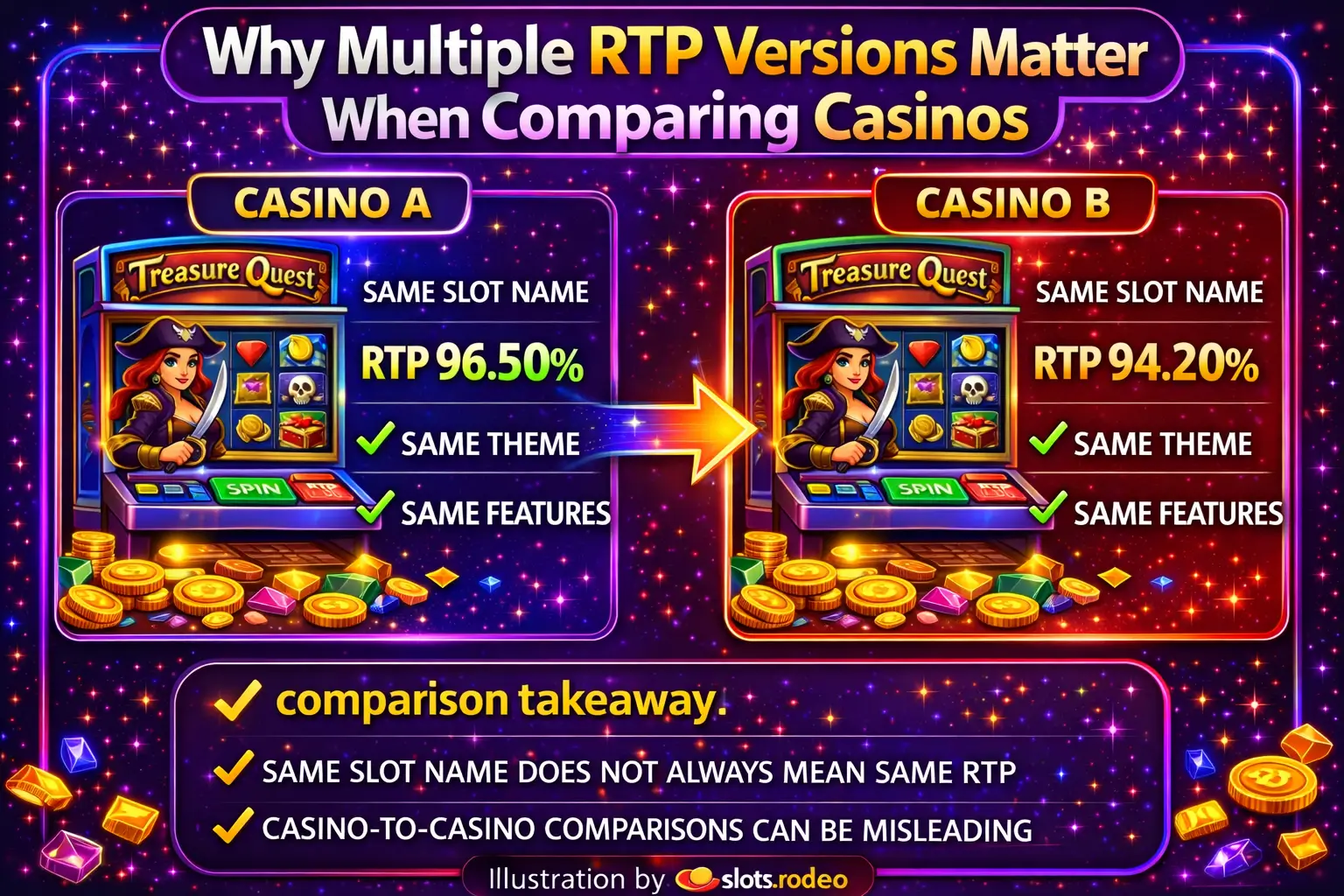
If Casino A and Casino B both feature the same slot, it does not guarantee that players will receive the same RTP.
This influences comparisons in three primary ways:
1. The same slot title may not imply identical returns
Players might believe that a familiar game consistently has a singular RTP. This belief can be misleading, as two versions of the same slot can have differing theoretical returns.
2. Review pages may become misleading if they overlook version variations
A website might report one RTP figure for a slot without verifying if that figure is applicable across all casinos, leading to confusion, especially during side-by-side comparisons.
3. A reduced RTP impacts long-term calculations
The variance may seem minor on paper but affects the expected theoretical return over time.
| RTP version | Theoretical return per 100 wagered | Theoretical house edge |
|---|---|---|
| 96% | 96 | 4% |
| 94% | 94 | 6% |
| 92% | 92 | 8% |
96%
94%
92%
This table doesnotforecast outcomes for a single session. It simply indicates that lower RTP corresponds to a lower theoretical return over the long term.
Does a reduced RTP mean the slot experience will differ immediately?
Not necessarily.
RTP serves as a theoretical long-term metric. In a brief session, players may not observe any noticeable differences. A lower-RTP variant does not ensure a poor session, nor does a higher-RTP variant guarantee a favorable one.
The crucial aspect is not about short-term outcomes. The key point is that when two casinos present different RTP versions for the same game, they do not provide equivalent long-term value.
Where players can locate the RTP version
The most straightforward place to verify this is typically the in-game help section, paytable, or information menu. Some slots clearly present the RTP on the rules screen, while others may make it less apparent.
When comparing the identical slot across casinos, check:
- the RTP shown inside the game
- the paytable or help file
- whether the casino publishes slot details accurately
- whether a review page names the exact RTP version rather than assuming one universal figure
If no RTP is shown in the game interface, comparison becomes weaker because the player cannot confirm whether both casinos are offering the same version.
A simple example of how confusion happens
A player sees Slot X reviewed online as "96.1% RTP."
Then the same player opens Slot X in a casino and finds "94.0% RTP" in the rules.
This does not automatically mean one of the numbers is fake. It may simply mean:
- the review used a different RTP version
- the game exists in multiple configurations
- the review did not specify which version it referred to
That is why slot comparisons should focus on theversion actually shown in the gamenot only on the slot title.
What this means for slot reviews and database pages
A strong slot page should avoid presenting RTP as a single universal number unless the version has been verified. A more accurate approach is:
- show the RTP found in the reviewed game instance
- mention that other RTP versions may exist
- avoid implying that the same figure applies everywhere
- separate game-level facts from operator-level conditions
This improves trust and reduces misleading comparisons.
FAQ
Common questions about this topic.
Yes. A provider may release more than one RTP version of the same slot. The game can look the same while the theoretical return differs.
Usually no. In most cases, the provider supplies the available RTP configurations, and the casino offers one of those supported versions.
Not in the way players usually mean it. It is generally the same game title and same core product, but with a different theoretical long-run return setting.
Usually not. The most reliable place to check is inside the game's help, info, or paytable section.
No. RTP is a long-run theoretical measure, not a prediction for a short session.
