

A visually appealing slot may not necessarily align with your preferred playing style.
Certain games are easier to understand due to their consistent layout. Others might feel more dynamic with frequent feature activations. Some are selected for their potential for higher payouts, despite longer periods of inactivity between significant wins.
Thus, the pertinent question isn’t "which slot is the best?" Instead, it is"which slot aligns with the kind of gaming session I desire?"
This guide focuses on aligning slot design with player preferences. It does not forecast results but aids in selecting a game style that is suitable before you begin playing.
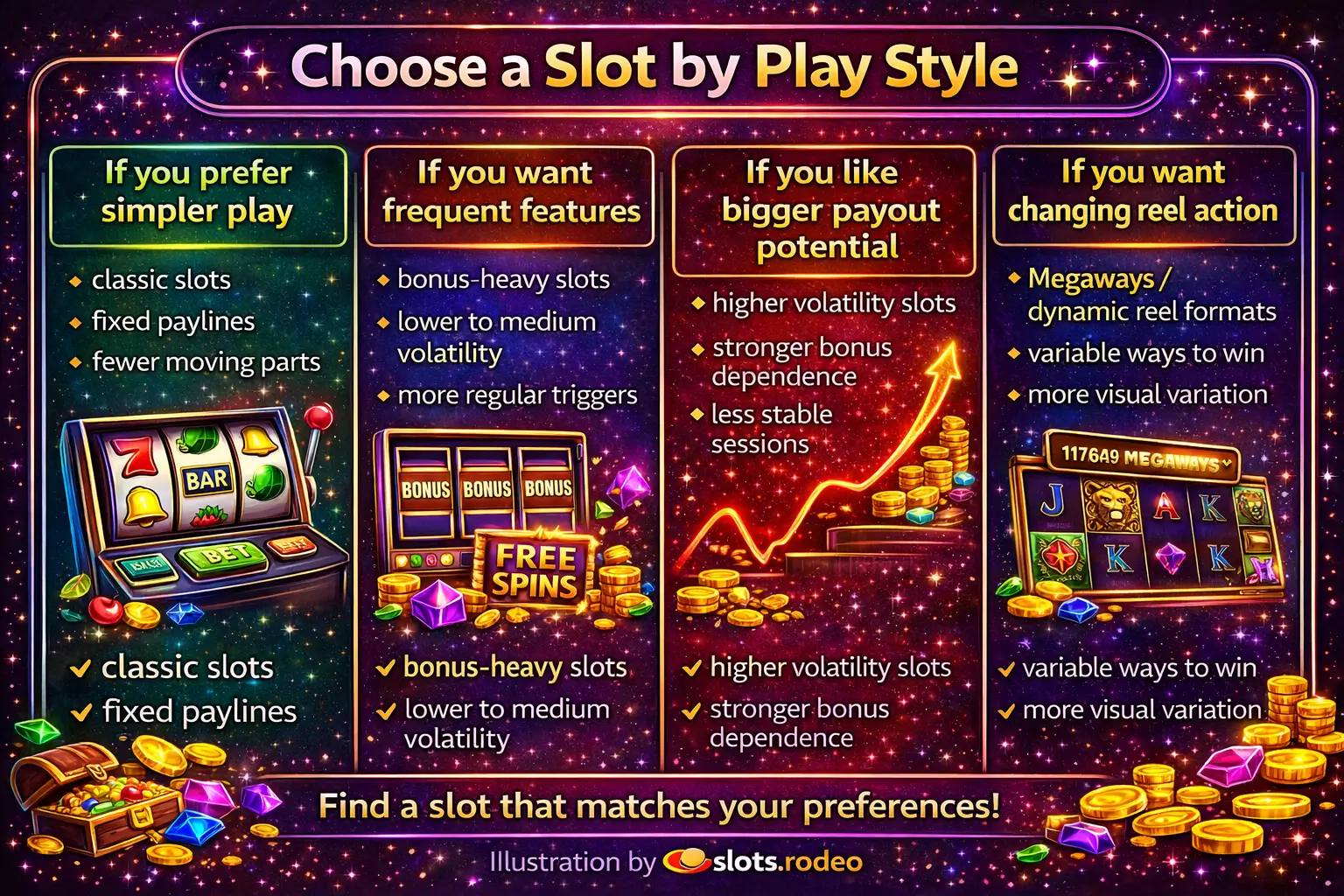
Identify what matters most to you initially
Before evaluating options, establish what is most important to you during a gaming session.
For numerous players, it often includes one of these:
- a layout that is straightforward and easy to navigate
- features that appear more regularly
- higher payout potential
- a more consistent session experience
- greater activity and varying reel dynamics
This one decision can significantly reduce unsuitable options.
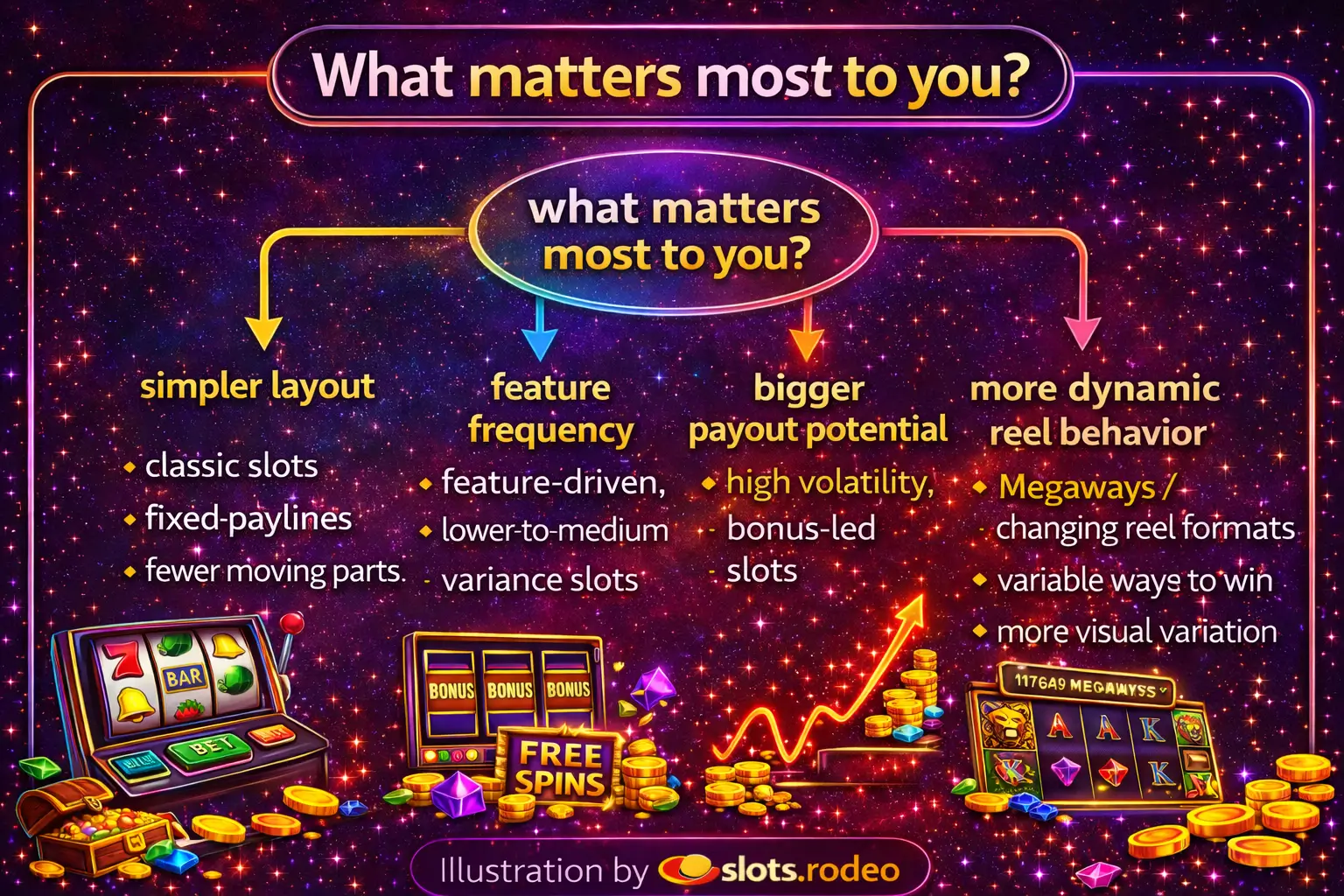
Typical characteristics of the main slot styles
While there isn’t a universally accepted method for categorizing slots, these general classifications are sufficient for making informed choices.
| Slot style | Usual feel | Why some players choose it | Main trade-off |
|---|---|---|---|
| Classic-style slots | Simple, stable, easy to read | Clear reel behavior and less visual noise | Usually less variety in features |
| Traditional video slots | Familiar modern format with bonus features | Balanced mix of theme, structure, and features | Can differ a lot from one title to another |
| Slots with low to medium volatility | Smoother session pacing | Smaller events may appear more often | Top-end upside is often lower |
| Slots with high volatility | Swingier session pattern | Bigger payout potential | Longer dry stretches can happen |
| Megaways or dynamic-layout slots | Reel structure may change often | More dynamic spin-to-spin behavior | Harder for beginners to track |
| Cluster or cascade-centric slots | Chain reactions and board changes | More active session feel | Layout logic may be less intuitive |
Traditional-style slots
Typical video slots
Slots with low to medium volatility
Slots with high volatility
Megaways or adjustable-layout slots
Cluster or cascade-centric slots
While categories provide guidance, they are merely a starting point. Two slots within the same broad category can still offer vastly different experiences due to bonus distribution, symbol values, and feature mechanics.
If you prefer something easy to navigate
Certain players prefer not to deal with varying reel heights, multiple side meters, or numerous overlapping mechanics displayed simultaneously. They prefer to view a spin result and grasp it instantly.
This generally makes these types more appropriate:
- classic-themed slots
- fixed-payline titles
- standard video slots with straightforward bonus mechanics
- games with minimal on-screen modifiers
Such games tend to be more suitable for novice players due to their clearer structure. You invest less time deciphering the interface and more time determining if the game aligns with your preferences.
Simple does not equate to outdated or ineffective. It simply indicates that the game relies less on mechanical intricacies.
If you prioritize feature occurrence
Many players prefer games that maintain a sense of activity. They are interested in engaging events rather than enduring a prolonged series of unremarkable losing spins.
In practical terms, this can translate to:
- cascades
- respins
- regularly appearing modifier symbols
- additional features beyond the main bonus round
- low to medium volatility ratings
However, it is crucial to analyze feature frequency carefully. A game may activate features often, but those features might not yield significant rewards. Increased activity does not necessarily equate to better outcomes.
Therefore, if maintaining engagement is your main concern, focus on games where the features deliver value, rather than simply keeping the visuals busy.
If the potential for higher payouts is more important to you
Some players are willing to accept less consistency in their sessions because they prioritize significant wins.
These players typically concentrate on:
- high-volatility slots
- robust free spins rounds
- features loaded with multipliers
- impressive maximum win statistics
This approach can be logical, but it's vital to understand the trade-off. Slots with greater potential for wins often concentrate their value in infrequent occurrences, which can result in:
- extended intervals without substantial returns
- increased pressure on your bankroll if the betting amount is too high
- a gameplay experience that feels subdued until a favorable feature activates
Thus, if you are selecting based on payout potential, do not focus solely on maximum win figures. Evaluate whether the volatility and bonus framework align with the level of variance you are comfortable experiencing.
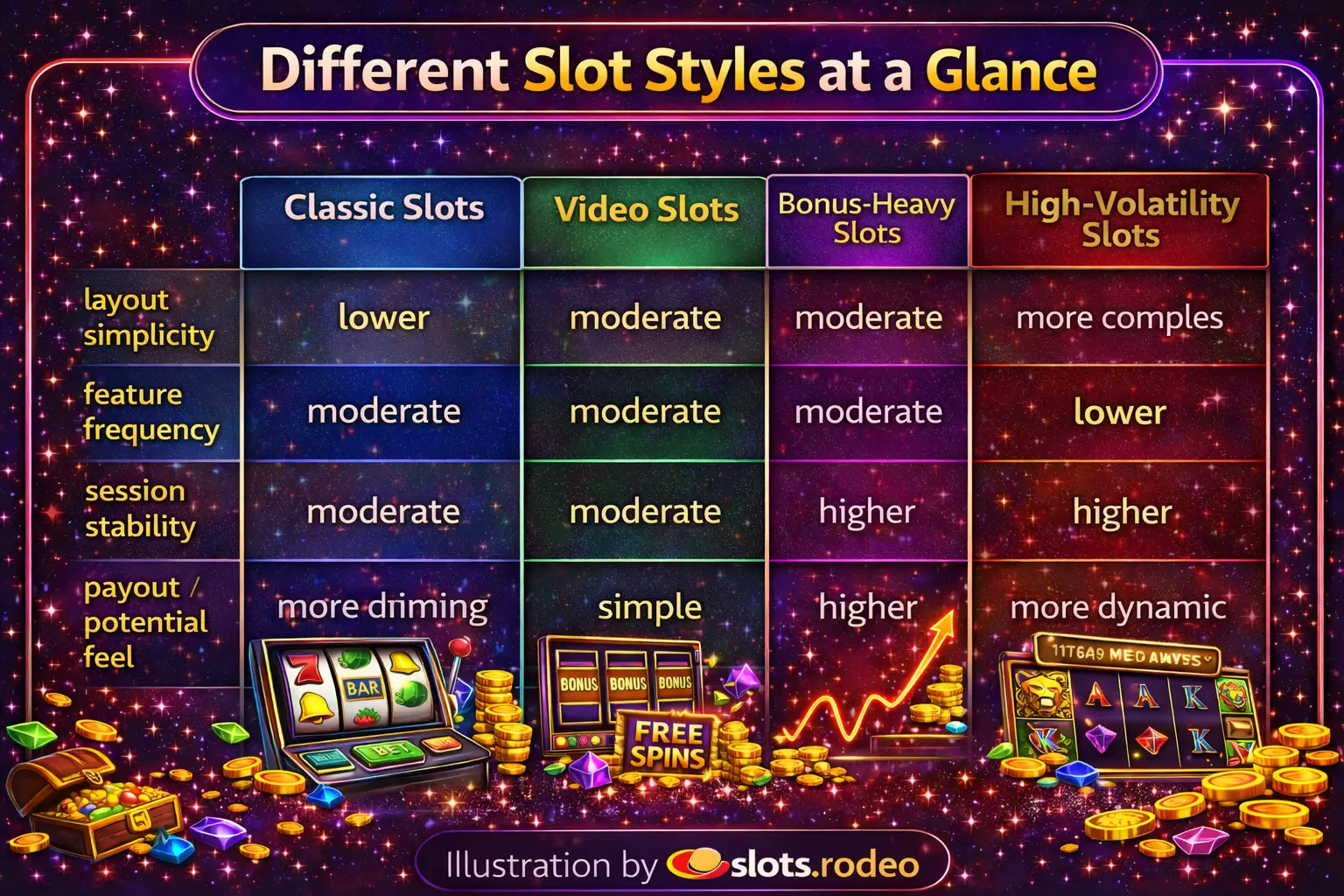
Factors to consider when comparing two slots
Theme tends to be the least significant aspect for comparison. The structure is more critical.
A straightforward practical evaluation should include the following:
| What to compare | Why it matters |
|---|---|
| Layout type | A fixed layout is usually easier to follow than a changing one |
| Volatility classification | Helps estimate whether the session may feel steadier or swingier |
| Bonus framework | Shows whether value is spread across small events or concentrated in rare features |
| Maximum win amount | Gives a rough idea of upside, but not how often strong outcomes happen |
| Mechanics of features | Helps you judge whether the game will feel calm, busy, simple, or layered |
| Displayed RTP version | Matters because the same slot can exist in more than one RTP configuration |
Layout type
Volatility classification
Structure of bonuses
Maximum win amount
Mechanics of features
Displayed RTP version
This provides insights beyond just theme, aesthetics, or perceived excitement of the game.
Examples of play-style alignment
These are guidelines rather than strict rules, serving as helpful shortcuts.
| Your preference | Slot styles that may fit better | Why |
|---|---|---|
| "I prefer something straightforward to understand" | Classic slots, fixed-payline video slots | Stable layout and clearer win formation |
| "I want the game to have more frequent activations" | Lower-to-medium volatility feature slots, cascade games | More visible events during the session |
| "I'm more interested in higher potential rewards" | High-volatility bonus-led slots | More value may be concentrated in rarer events |
| "I prefer less cluttered screens" | Simpler layouts with fewer modifiers | Lower visual and mental load |
| "I seek more dynamic reel actions" | Megaways and other variable-layout slots | Reel state can change from spin to spin |
"I want an interface that is easy to interpret"
"I want the game to provide more frequent actions"
"I'm more interested in higher potential rewards"
"I prefer less cluttered screens"
"I seek more dynamic reel actions"
Use these as an initial filter, then review the rules and paytable prior to final selection.
Common mistakes made by novices
A frequent error is selecting a slot based solely on its theme. Even if the theme resonates with you, it might not align with your preferred playing style.
Another misstep is the belief that an abundance of features equates to a superior game. In truth, additional mechanics can clutter the gameplay without enhancing its suitability.
A further error is opting for a high-potential game without moderating your expectations. Higher win potential often correlates with a less consistent session experience. This is not a defect but a design characteristic.
The more effective strategy is straightforward:
- determine the type of session you desire
- analyze the slot configuration
- evaluate the volatility rating, features, and design
- disregard assertions based on winning streaks, luck trends, or outcomes that seem "due"
A more insightful perspective on selecting slots
Choosing a slot primarily revolves around identifying asession profile.
You are not merely picking a machine that will pay out. You are choosing a game framework:
- straightforward or complex
- consistent or variable
- feature-rich or reliant on bonuses
- static or adaptable in design
When you adopt this viewpoint, the selection process becomes considerably simpler. The optimal slot for your gaming style is generally the one whose mechanics align with what you seek, engage with, and can handle during a session.
