

Demo mode is one of the easiest ways to understand how a slot works before looking at real-money play.
It lets you inspect the game's structure without financial pressure. You can check the paytable, symbol rules, win system, free spins, bonus flow, and how the slot feels over a sample of spins. Used correctly, demo mode is a practical research tool.
Used badly, it becomes guesswork.
A common beginner mistake is to spin randomly for a few minutes and treat that as a full test. That is not enough. A useful demo test needs a clear method.
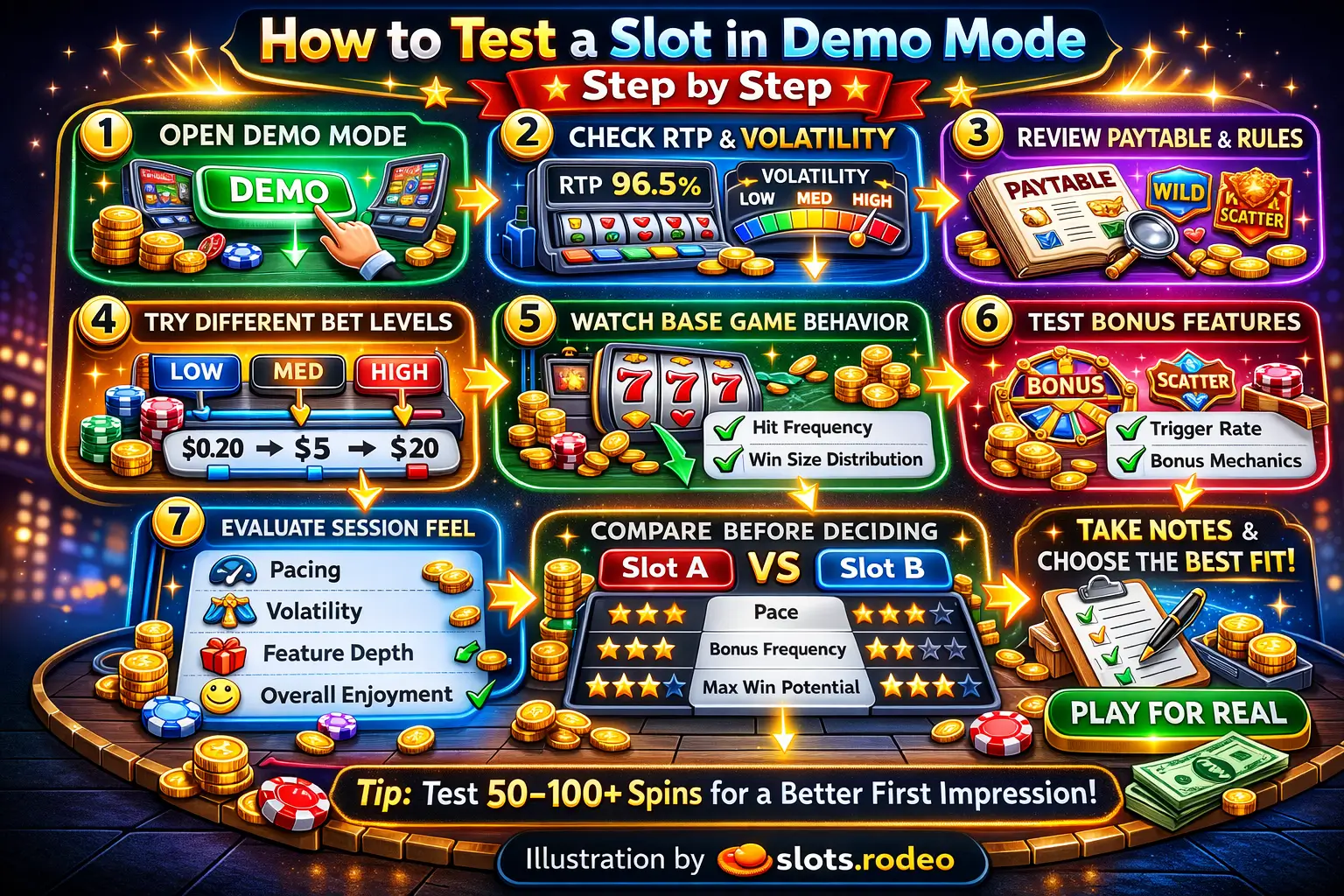
What demo mode is actually useful for
Demo mode is best for understanding the slot's design.
It helps you check:
- the win system
- symbol values
- wild and scatter rules
- bonus triggers
- free spins structure
- multiplier behavior
- reel layout
- general session feel
- how much the slot seems to depend on features
That makes demo mode useful for analysis, comparison, and simple slot literacy.
What demo mode is not for
Demo mode isnota reliable tool for proving:
- how the slot will behave in a real-money session
- how often you will win in live play
- whether the game is "hot" or "cold"
- whether one short sample proves the slot is good or bad
- whether the bonus is easy or hard to trigger in practice from a tiny sample
Those are common misunderstandings.
Demo mode helps you understandstructurenot predict your next outcome.
Start with the paytable before spinning
This is the first step most players skip.
Before you press spin, check:
- what win system the slot uses
- which symbols pay the most
- what the wild does
- what the scatter does
- how free spins are triggered
- whether there are multipliers, respins, or other special rules
- whether the game uses fixed paylines, ways to win, Megaways, or clusters
If you skip this step, you may watch the reels without understanding what the game is actually doing.
What to check first in demo mode
A simple first-pass review should focus on the core structure.
| What to check first | Why it matters |
|---|---|
| Win system | Tells you how wins are formed |
| Symbol values | Shows premium vs low-value symbols |
| Wild rules | Explains substitution and multiplier logic |
| Scatter rules | Shows feature trigger conditions |
| Bonus structure | Helps you understand where the game's value may sit |
| Bet display | Prevents confusion between coins, credits, and money values |
Win system
Symbol values
Wild rules
Scatter rules
Bonus structure
Bet display
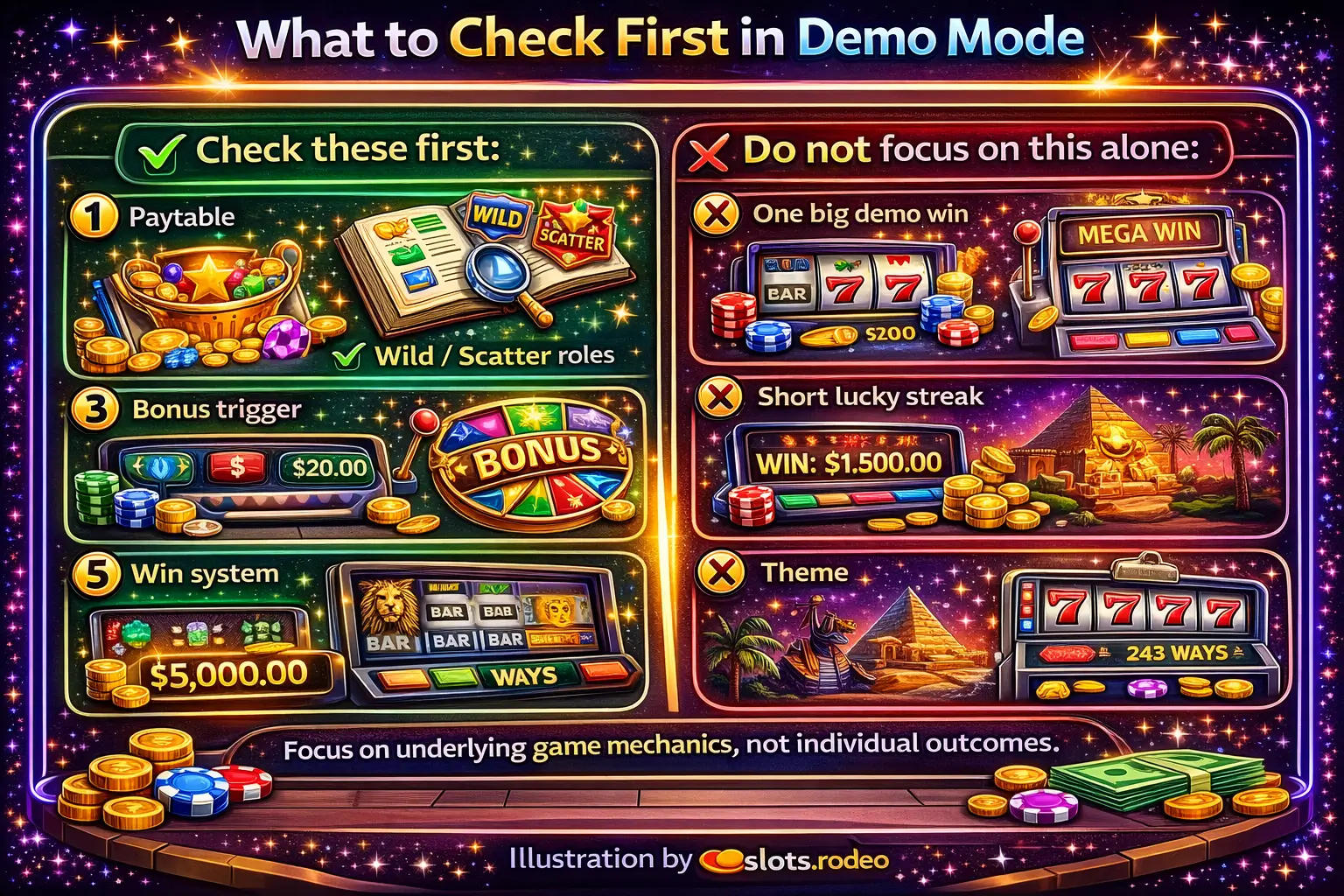
Step 1: Identify the win system
First, confirm how the slot forms wins.
Ask:
- does it use fixed paylines?
- does it use ways to win?
- is it a Megaways slot?
- does it use cluster pays?
This matters because it changes how you read the screen. If you do not know the win system, you may misread normal results from the start.
Step 2: Read the symbol ladder
Next, check the paytable and identify:
- low-value symbols
- premium symbols
- wild symbols
- scatter symbols
- bonus symbols
A good demo test is not only about watching wins happen. It is also about learning which symbols really matter.
Step 3: Watch the base game without rushing
Now start spinning, but do not spin blindly.
During the first sample, focus on the base game:
- how often does the slot produce visible wins?
- do many wins look small?
- does the base game feel active or quiet?
- do special symbols appear often or rarely in the sample?
- does the slot rely on cascades, expanding reels, or other ongoing mechanics?
At this stage, the goal is not to predict statistics. The goal is to observe structure and rhythm.
Step 4: Pay attention to losing stretches and small hits
A useful demo test should include attention to non-exciting outcomes too.
Watch for:
- long stretches without meaningful hits
- frequent small wins below stake
- repeated partial returns
- whether most visible activity comes from low symbols
- whether the base game seems to build toward a feature or stay flat
This helps you understand how the slot behaves between stronger moments.
Step 5: Test the special symbols properly
Once you have seen some normal spins, focus on the special symbols.
Check:
- does the wild only substitute, or also multiply?
- does the scatter pay directly, or only trigger features?
- can bonus symbols appear on all reels?
- do special symbols behave differently in bonus mode?
This step matters because many modern slots are shaped more by special symbols than by regular line hits.
Step 6: Inspect the feature if it triggers
If free spins or another bonus feature triggers during demo play, do not just watch the final total.
Check what changes inside the feature:
- do multipliers appear?
- do wilds change behavior?
- can the feature retrigger?
- do symbols upgrade?
- does the reel layout change?
- does the feature seem to carry much of the slot's value?
The point is to understandfeature structurenot just whether one bonus paid well or badly.
Step 7: Compare the base game and the feature
This is one of the most useful parts of demo testing.
A strong comparison should ask:
| Comparison point | Base game | Feature mode |
|---|---|---|
| Win activity | More or less frequent? | More or less concentrated? |
| Wild behavior | Standard? | Improved? |
| Multipliers | Limited or absent? | Added or stronger? |
| Reel modifiers | Basic? | Expanded or changed? |
| Value concentration | Spread out? | More feature-heavy? |
Win activity
Wild behavior
Multipliers
Reel modifiers
Value concentration
This helps you see whether the slot is mainly base-game-driven or bonus-driven.
Step 8: Test more than one short sample
One short burst of spins is rarely enough.
A better approach is to test the slot in separate small phases:
- first sample for basic structure
- second sample for rhythm and base-game feel
- later sample for bonus observation if possible
This gives you a broader picture than one random run.
That said, even several short samples are still just samples. They help you understand the game's layout and feel, not prove exact frequencies.
Demo mode testing checklist
A practical checklist makes testing more useful.
| Checklist item | Done? |
|---|---|
| Checked win system | Yes / No |
| Read symbol values | Yes / No |
| Confirmed wild rules | Yes / No |
| Confirmed scatter and bonus rules | Yes / No |
| Observed base-game rhythm | Yes / No |
| Watched size of common wins | Yes / No |
| Checked whether feature triggered | Yes / No |
| Compared base game vs feature | Yes / No |
| Noted whether slot seems feature-heavy | Yes / No |
| Avoided drawing conclusions from one short sample | Yes / No |
Checked win system
Read symbol values
Confirmed wild rules
Confirmed scatter and bonus rules
Observed base-game rhythm
Watched size of common wins
Checked whether feature triggered
Compared base game vs feature
Noted whether slot seems feature-heavy
Avoided drawing conclusions from one short sample
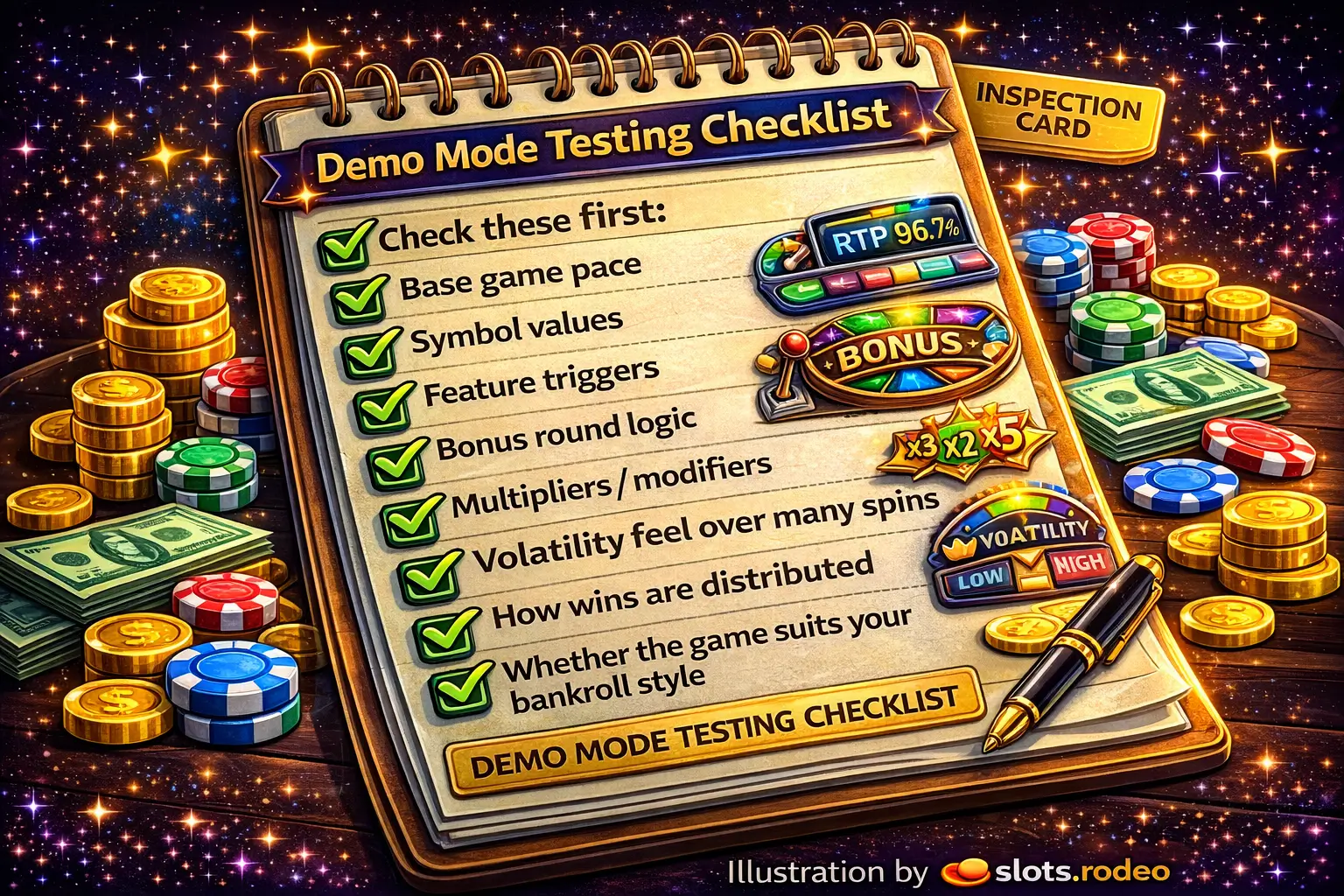
What demo mode can tell you well
Demo mode is good for the following:
- how the win system works
- whether the slot is simple or layered
- how the paytable is structured
- how special symbols behave
- if the feature alters gameplay significantly
- if the base game appears dynamic or stagnant
- if the slot is predominantly focused on bonuses
These illustrate effective applications of demo mode.
What demo mode fails to convey with reliability
Demo mode has its limitations.
It cannot consistently indicate:
- the psychological experience of a real-money session
- whether the next live play will be an improvement or a setback
- the precise bonus occurrence based on a limited sample
- the exact hit rate from a brief assessment
- if the slot is "due" for a win
- if the game is worthwhile based solely on a single favorable demo bonus
This is where numerous flawed tests falter.
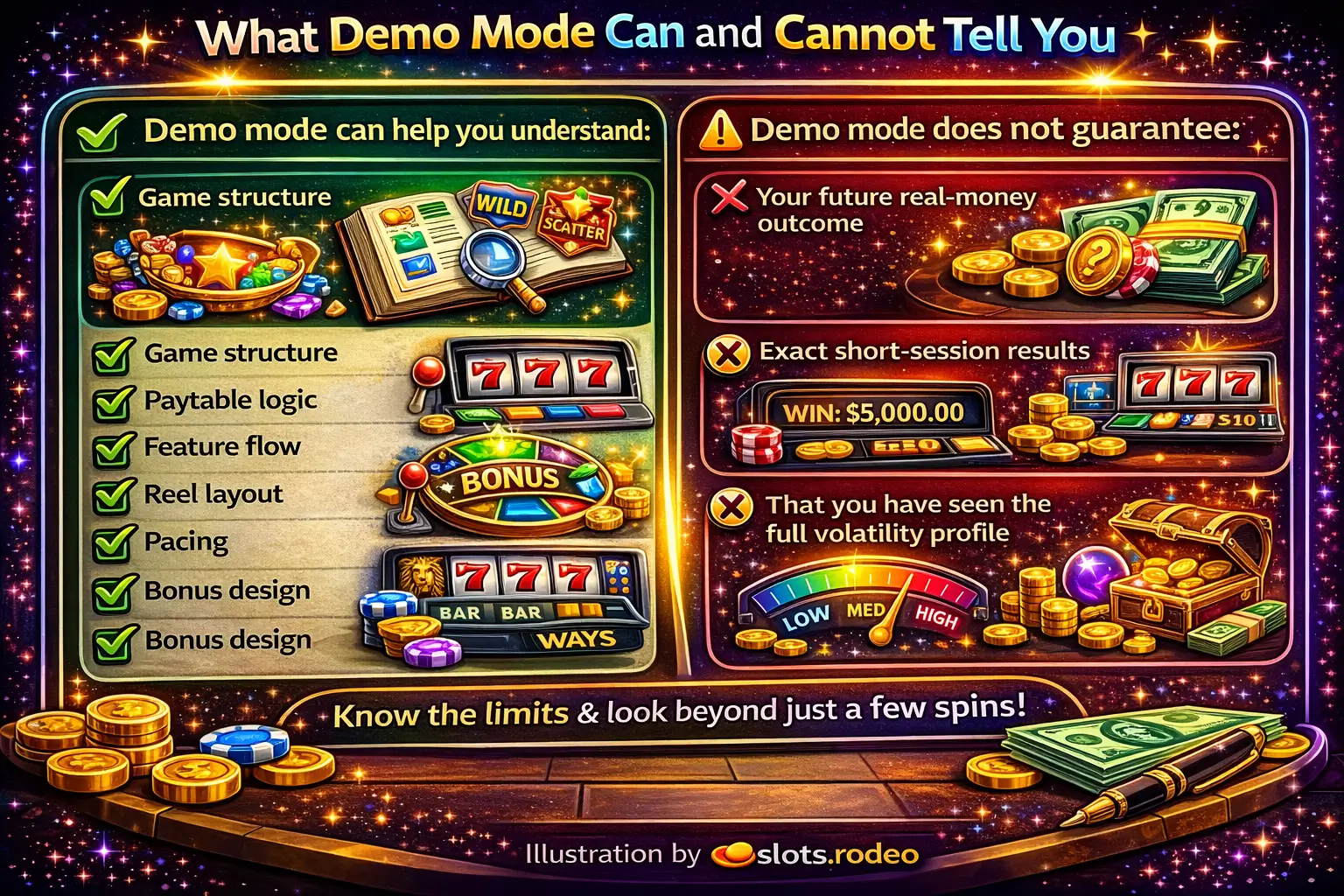
A single effective demo trial is more valuable than numerous arbitrary spins
A frequent error is to confuse volume with analytical insight.
Rapid spinning without monitoring observations often yields less understanding than a slower, more organized evaluation.
An effective demo trial should address queries such as:
- how this slot generates wins?
- where the value appears to reside?
- what functions the special symbols perform?
- how the feature differs from the base game?
- does the slot appear straightforward, complex, or heavily reliant on features?
If you can articulate those clearly, the trial was productive.
Incorrect approach versus proper method for testing a slot in demo mode
A poor demo trial resembles this:
- spin rapidly for five minutes
- wish for a bonus
- observe one favorable or unfavorable outcome
- form a conclusive opinion
A more effective demo trial resembles this:
- review the paytable first
- determine the winning system and special symbols
- analyze the base game
- observe how frequent wins appear
- examine the structure of features
- contrast the base game with the bonus round
- do not turn a limited sample into a definitive statement
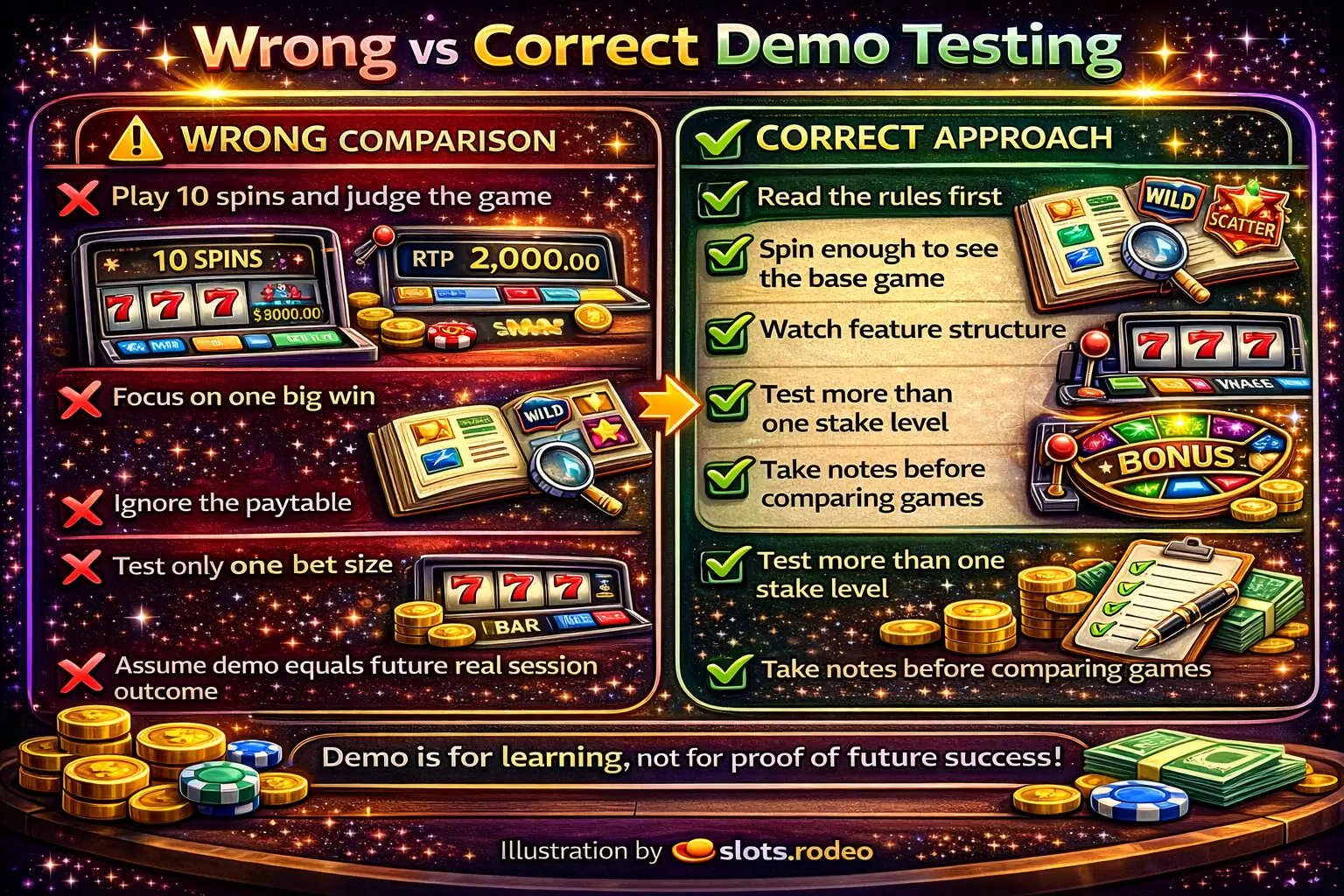
Common errors made by beginners in demo testing
Spinning without reviewing the paytable
This leads to fundamental misconceptions about symbols and triggers.
Evaluating the slot based on a single bonus outcome
One feature outcome does not represent the entirety of the game.
Considering demo mode as a forecasting tool
Demo mode is useful for understanding structure, not predicting real-life results.
Neglecting the base game
Many players only consider whether free spins show up, yet the base game is significant too.
Observing wins without assessing their value
A slot may appear active while yielding many low returns.
Mistaking "numerous hits" for "high value"
Regular visible wins do not necessarily indicate substantial returns.
An effective approach for testing any slot in demo mode
Follow this sequence:
- review the paytable
- determine the winning system
- examine the special symbols
- observe the base game mechanics
- record the average size of wins
- check the feature if it activates
- compare the base game with the feature
- document straightforward conclusions about the structure
This approach suffices for most practical demo evaluations.
What insights are reasonable post-demo test
Following a thorough demo test, it is reasonable to conclude that:
- the slot predominantly features bonuses
- the base game appears to be subdued
- the feature significantly alters reel behavior
- the winning system is either straightforward or more complex to interpret.
- the slot heavily relies on multipliers
- the paytable can be straightforward or complex
It isnotit's reasonable to express ideas like:
- this slot tends to pay out well
- this slot is not performing well
- this slot consistently offers minimal bonuses
- this slot will operate similarly in actual gameplay
This differentiation is significant.
FAQ
Frequently asked questions regarding this subject.
The primary goal is to grasp the game's framework, symbols, payout mechanics, and feature layout.
Indeed. That is a critical step.
It can indicate if the slot is straightforward, feature-rich, engaging, or inactive, but it cannot definitively assess overall worth from a brief sample.
Typically not. It's advisable to analyze multiple short samples and concentrate on structure rather than results.
No. While it aids in understanding the slot, it cannot forecast real-time results from a limited test.
