

RTP stands forReturn to Player. It is among the most frequently referenced metrics in slots, yet often misinterpreted.
Numerous players encounter a figure like96% RTPand presume it indicates they can expect to recover 96% of their stake during a typical session. This is a misconception about RTP.
RTP is along-term theoretical returnintegrated into the game's mathematics. It indicates how the slot is structured to provide returns over a significant number of spins. It does notnotpredict outcomes for an individual session, a single hour, or even multiple consecutive sessions.
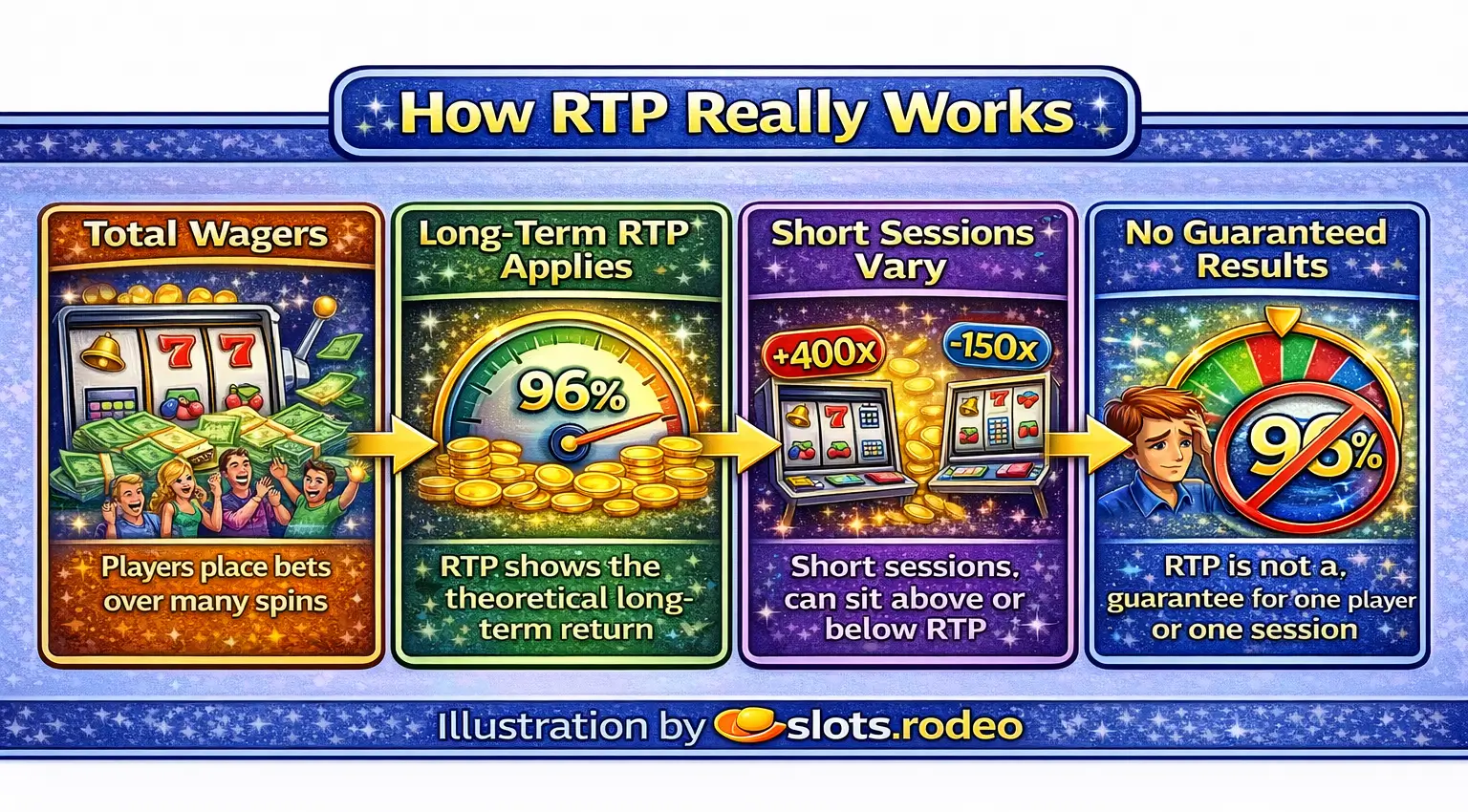
Simplifying the Concept of RTP
If a slot has96% RTPthe theoretical interpretation is:
- across a vast number of plays
- the game is designed to yield approximately 96 units
- for every 100 units wagered cumulatively
The remaining 4 units represent the inherent house edge.
That doesnotmean:
- each player recovers about 96 for every 100 spent
- in a session of 100 spins, one should expect to receive nearly 96
- the slot ostensibly "owes" you the deficit of 4
- the game becomes increasingly likely to pay out since you are under the RTP figure
RTP serves as a design statistic, not a guarantee for any session.
RTP pertains to the game mechanics, not your specific results
This clarification addresses most misunderstandings.
RTP is part of themathematical framework of the slot. It does not constitute a guarantee related to your balance or personal play session.
A player can:
- end up significantly above RTP in a brief session
- end up significantly below RTP in a brief session
- trigger a bonus early and leave with a profit
- receive minimal returns over a limited series of spins
All these results can occur in a slot that has the same declared RTP.
Reasons why brief gaming sessions may not reflect the RTP.
Slots do not distribute payouts in a consistent manner.
They pay out through:
- numerous losing spins
- small wins
- medium wins
- infrequent feature activations
- occasional larger wins
Due to this, short-term gameplay can greatly deviate from the long-term return percentage.
Here’s a straightforward example:
| Session size | Possible relationship to RTP |
|---|---|
| 20 spins | Can be far above or far below RTP |
| 100 spins | Still highly unstable |
| 500 spins | More data, but still noisy |
| Extremely high number of spins | More likely to move closer to theoretical RTP |
20 spins
100 spins
500 spins
Extremely high number of spins
The main point is thatsample size is crucial. RTP gains significance as the spin count becomes very high.
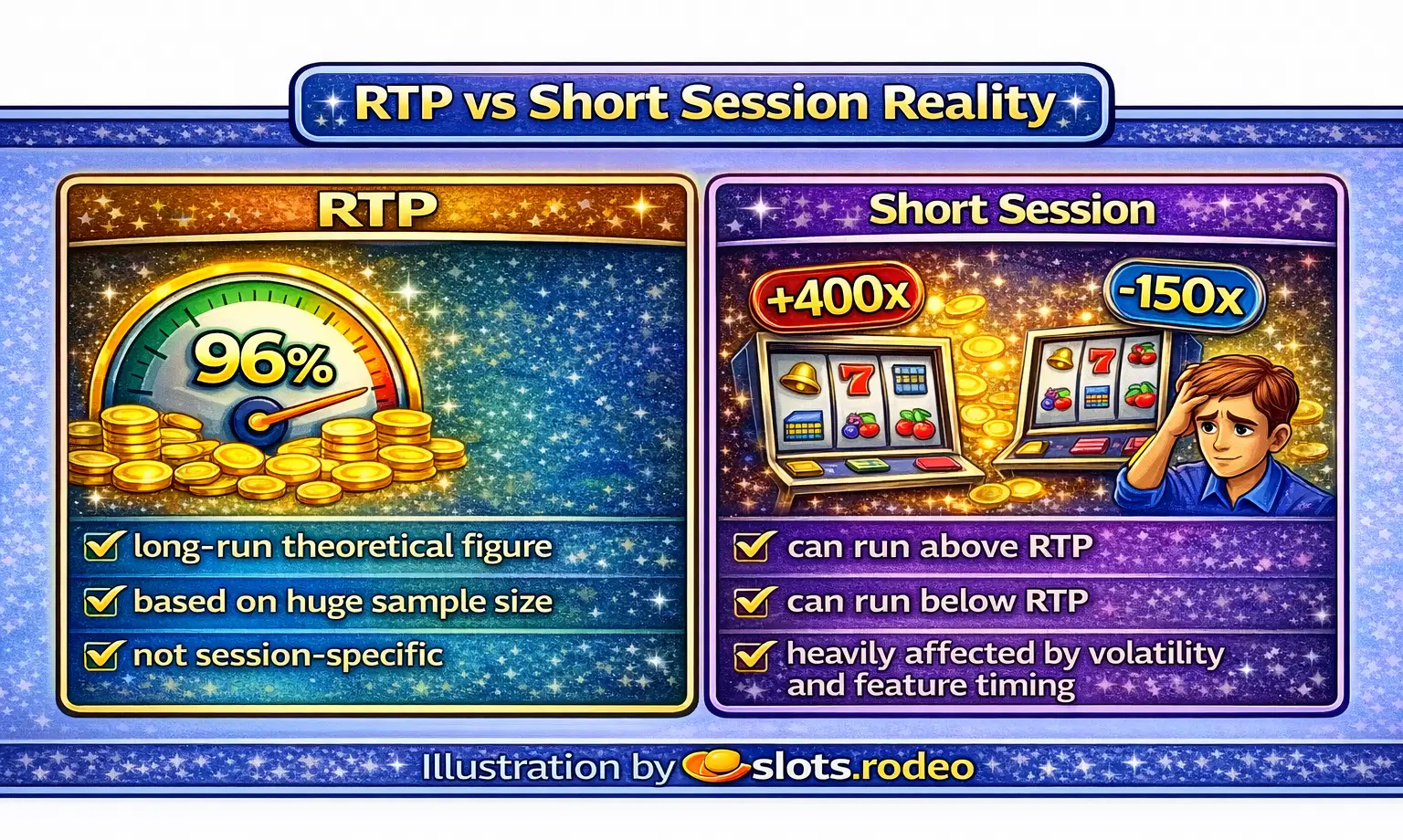
RTP is a theoretical figure, not a real-time session tracker.
A slot does not continuously assess your session to align with its RTP value.
It doesn't function like this:
- you are below 96%, so the game should increase payouts now
- you are above 96%, so the game should decrease payouts now
This is not how conventional slot mathematics operates.
The slot simply applies its preset rules on every spin. Over a long duration, the cumulative outcomes from extensive play are anticipated to match the theoretical return profile. However, the game does not adjust your session in real-time.
How RTP is typically allocated within a slot
The stated RTP often does not derive from just one segment of the game.
It can be divided among various components such as:
| Slot component | Possible RTP contribution |
|---|---|
| Base game line wins | Part of total RTP |
| Scatter payouts | Part of total RTP |
| Feature for free spins | Often a major part |
| Rounds with bonuses | Sometimes meaningful share |
| Modifiers or multipliers | Embedded in total game return |
Wins from base game lines
Payouts from scatters
Feature for free spins
Rounds with bonuses
Modifiers or multipliers
This is important because two slots with identical RTP values can exhibit vastly different behaviors if one emphasizes bonus features while the other relies more on base-game wins.
A slot with 96% RTP does not necessarily play the same as another slot with 96% RTP in shorter sessions.
RTP does not equate to hit frequency
RTP indicates the long-term percentage of return. It doesnotnot specify how often the slot pays out.
A slot may have:
- fairly regular small payouts with 96% RTP
- infrequent but larger payouts and still have 96% RTP
Both scenarios are feasible as RTP assesses total returns rather than payment patterns.
This is why RTP should not be mistaken for:
- frequency of hits
- volatility
- frequency of bonuses
- maximum win capability
These elements represent distinct aspects of slot gameplay.
RTP differs from volatility
This is another frequent misconception.
A high-volatility slot and a low-volatility slot can both present the same RTP, but the way to achieve that RTP may vary significantly.
For instance:
| Slot type | Possible profile |
|---|---|
| Low-volatility slot | More regular small and medium returns |
| High-volatility slot | Longer dry periods with more value concentrated in bigger outcomes |
Low-volatility slot
High-volatility slot
Both could have an RTP of 96%.
Thus, RTP indicatesthe amount the game is programmed to return over an extended periodwhereas volatility clarifieshow that return might be distributed.
RTP does not indicate when a bonus will activate
An RTP figure does not reveal:
- when free spins will initiate
- when a multiplier will trigger
- if the next play session will be more favorable
- if the game is currently 'overdue'
- how long a dry spell might continue
This is crucial because many players erroneously treat RTP as a timing predictor. It is not.
A slot with a 96.5% RTP might still experience lengthy periods without a significant win. Conversely, a slot with a slightly lower RTP can yield a robust short session.
Why the same slot can be offered in different RTP formats
Some slots are launched with multiple RTP options.
This means the same game title could be available at, for instance:
- 96.5%
- 95%
- 94%
- or another designated value
The rules, visuals, and basic mechanics may appear nearly identical, yet the theoretical return can vary depending on the selected version.
This underscores the importance of verifying the actual RTP displayed in the game help screen rather than relying on a default figure based on the slot's general standing.
A straightforward illustration of how to interpret RTP
Consider a slot with96% RTP.
If total bets over a significant number of plays equal$1,000,000the theoretical framework suggests approximately$960,000is returned to players over time, while roughly$40,000is retained as the house edge.
That doesnotmean:
- a $100 session yields a return of $96
- players effectively lose $4 for every $100 wagered
- after 100 spins, results should approximate 96%
Some sessions can result in:
- $0
- $40
- $85
- $140
- substantially exceeding the initial balance
All these outcomes can occur within the same RTP structure.
The purpose of RTP
RTP remains valuable when interpreted accurately.
It aids you in:
- comparing theoretical returns across different slot variations
- grasping the long-term return framework of the game
- distinguishing a brief session from the overall game profile
- identifying when one slot version has a significantly lower theoretical return than another
When used this way, RTP serves as a useful benchmark.
When utilized as a predictor for short sessions, it can be deceptive.
Frequent misunderstandings players have regarding RTP
Considering RTP as a promise for a single session
It does not assure outcomes for a brief gaming session.
Believing the slot will quickly "even out"
Theoretical return requires a substantial sample size. Short-term outcomes can deviate significantly from it.
Mistaking RTP for volatility
RTP quantifies long-term returns, while volatility refers to payout distribution and variance.
Assuming that all versions of a slot share the same RTP
Certain titles are available with varying RTP settings.
Using RTP to forecast the next spin
RTP does not predict future results.
What RTP fails to convey
RTP is beneficial but has limitations.
It doesnottell you:
- the frequency of payouts from the slot
- the size of most winnings
- the perceived volatility of the game
- the amount of RTP allocated to bonus rounds
- the difficulty in activating free spins
- the likelihood of short sessions feeling smooth or rough
- whether the ongoing session is perceived as "good" or "bad" in comparison to what may follow
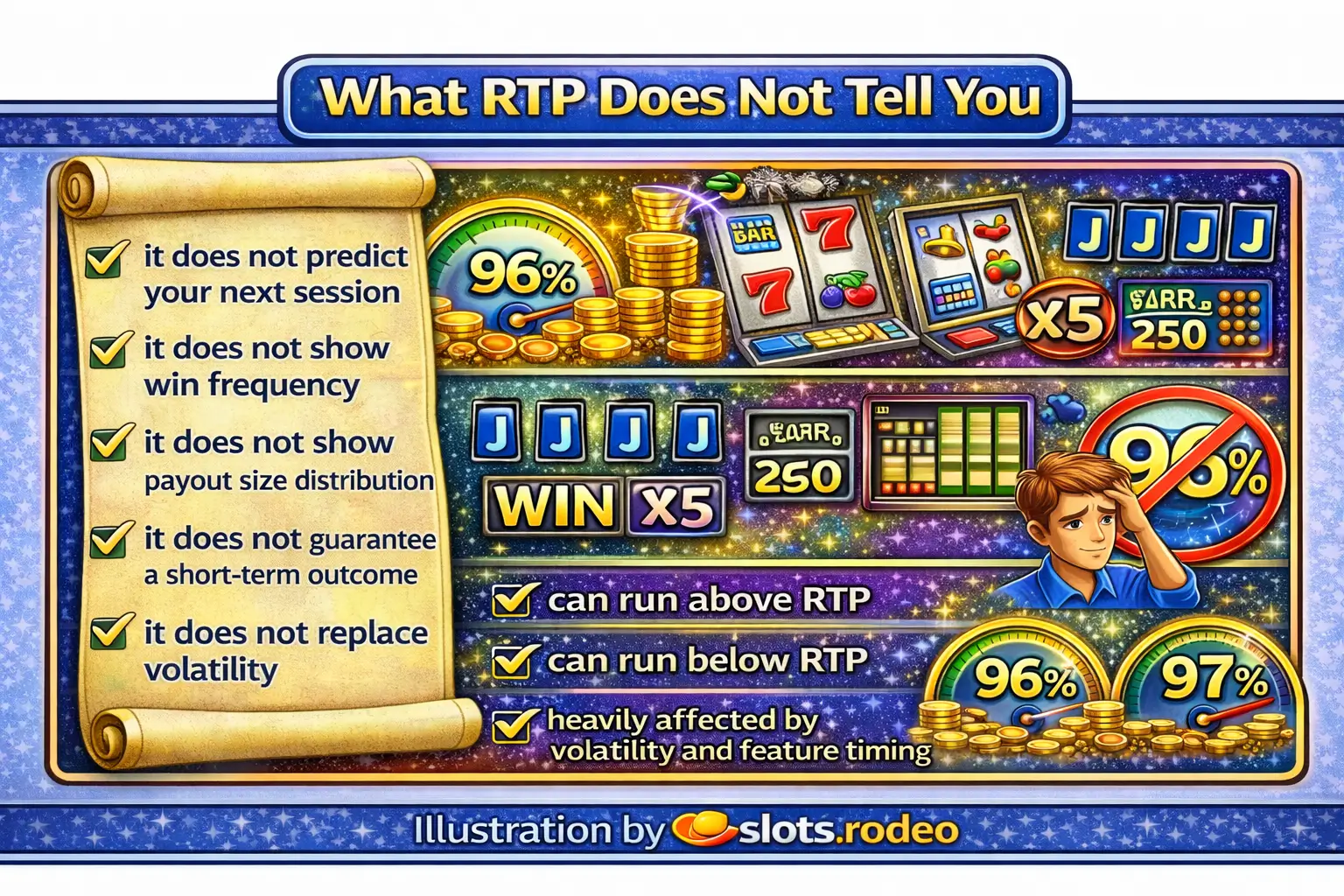
RTP and real session outcomes
A practical way to think about RTP is this:
- RTP is the blueprint
- your session is one small sample taken from that blueprint
The smaller the sample, the less closely it may resemble the full design.
This is normal. It does not mean the RTP is false. It means short-term variance is part of how slots work.
How to use RTP correctly when comparing slots
If you want RTP to be useful, apply it in a narrow and realistic way.
Check:
| What to compare | Why it matters |
|---|---|
| Exact RTP version shown in the game | The same title may exist in different RTP settings |
| RTP together with volatility | Return and payout pattern are different metrics |
| RTP together with feature structure | Bonus-heavy slots may feel different from base-game-heavy slots |
| RTP as a long-term indicator only | Prevents bad session-level assumptions |
Exact RTP version shown in the game
RTP together with volatility
RTP together with feature structure
RTP as a long-term indicator only
This gives you a much clearer picture than looking at RTP alone.
FAQ
Common questions about this topic.
No. It means the slot is theoretically designed to return 96% over a very large amount of total play, not in each personal session.
Yes. Short sessions can sit far below or far above the listed RTP.
No. RTP is long-term return. Hit frequency is about how often wins occur.
No. RTP does not predict timing, feature frequency, or the next result.
Yes. Some slots are offered in multiple RTP configurations, so checking the in-game value matters.
