

Max win in slots refers to the highest potential payout a game can generate from a single completed spin or feature sequence based on its rules.
It is typically displayed as a multiple of your wager, such as:
- 5,000x bet
- 10,000x bet
- 50,000x bet
When a slot indicates amax win of 10,000xthis signifies that the maximum theoretical win is 10,000 times the initial bet.
While this may seem straightforward, max win is frequently misinterpreted by players. Many mistakenly view it as a representation of what the game 'usually pays out.' This is not its true meaning.

Simplifying the concept of max win
The max win is the maximum payout limit specified within the game’s mathematics and guidelines.
If your wager is$1and the max win is5,000xthe maximum theoretical payout would be:
$1 x 5,000 = $5,000
If your wager is$0.20and the max win is5,000xthe maximum theoretical payout would be:
$0.20 x 5,000 = $1,000
The x-bet value remains constant, while the monetary value fluctuates based on the stake.
Max win is a theoretical value, not a standard expectation
This is a crucial aspect to understand.
Max win does not imply thatnotmean:
- a typical strong session should achieve that amount
- the slot frequently pays around that figure
- most bonus features are centered on that outcome
- the game is expected to reach that cap during regular play
Max win represents theouter limitstructure of the game's payouts, not a reflection of average or frequent results.
A slot with a max win of 20,000x can still result in numerous sessions yielding minimal wins or no feature activations whatsoever.
How max win is typically presented
Most providers express max win as a multiple of the total wager.
Examples:
| Listed max win | Meaning at $0.20 bet | Meaning at $1 bet |
|---|---|---|
| 1,000x | $200 | $1,000 |
| 5,000x | $1,000 | $5,000 |
| 10,000x | $2,000 | $10,000 |
| 50,000x | $10,000 | $50,000 |
1,000x
5,000x
10,000x
50,000x
This x-bet structure allows for easier slot comparisons without linking the amount to a specific currency value.
Sources of the maximum win
In numerous slots, the maximum win isn't derived from a straightforward base-game line hit.
It frequently relies on a sequence of favorable circumstances, such as:
- combinations of premium symbols
- complete alignment of bonus features
- multipliers that are stacked
- retriggers
- setups with maximum-value wilds
- symbols that expand
- progression through bonus rounds
- optimal reel or cluster setups
In other terms, the stated maximum win typically indicates abest-case scenariorather than a typical outcome.
The maximum win is frequently associated with the bonus feature
Numerous contemporary slots offer their largest potential wins during free spins or bonus rounds.
This suggests that the highest recorded win may hinge on:
- activation of the feature
- initiating the most powerful feature variant
- achieving several high-value modifiers
- aligning top symbols
- stacking multipliers or wild effects within the same outcome
This is the reason max win is often more related tothe design of featuresrather than typical base-game activity.

The maximum win is distinct from RTP
A slot can possess:
- average RTP paired with an exceptionally high maximum win
- elevated RTP alongside a diminished maximum win
- comparable RTP to another slot yet a markedly distinct maximum win limit
This is due toRTPandmax winassessing different aspects.
RTP
The expected return over an extensive number of spins in the long run.
Max win
The maximum theoretical payout or capped win.
A significant maximum win does not necessarily indicate greater overall returns. It suggests the slot accommodates a higher potential payout at the top end.
Maximum win differs from volatility
While maximum win and volatility are interconnected, they are not the same.
Slots with a very high maximum win often exhibit a top-heavy nature, as considerable value may be linked to infrequent, stronger results. However, the maximum win alone does not fully capture the volatility dynamics.
For instance:
- one slot could feature a 5,000x maximum win with moderate behavior
- another might offer a 50,000x maximum win yet still distribute value more evenly
- a third may present a lower maximum win but feel harsh due to bonus reliance
Thus, while the maximum win indicates the peak potential, volatility sheds light on the unevenness in the return journey.
A high maximum win does not inherently indicate a "better" experience for every player
Some players may presume that a larger maximum win automatically enhances a slot's appeal.
This perspective is overly simplistic.
A larger maximum win could imply:
- greater theoretical upside at the top end
- increased focus on rare peak events
- more value concentrated in unique feature outcomes
However, it may also suggest:
- standard outcomes remain significantly lower
- numerous sessions may not approach the maximum win
- the bonus round may hold the majority of the game's significant payout potential
Consequently, while the maximum win is informative, it should be interpreted as a structural indicator rather than a direct quality assessment.
The reasons max win appears more crucial than it truly is
Maximum win is straightforward to promote since it represents a substantial figure and is easy to compare.
However, when considered in isolation, it overlooks much practical context, including:
- the challenge of achieving that outcome
- whether it relies on multiple rare events occurring simultaneously
- how much of the slot's overall value lies significantly below the maximum
- the game's performance during shorter playing sessions
This is why max win can be informative but also misleading when taken alone.
Max win often depends on perfect conditions
In many slots, reaching max win requires a near-ideal sequence.
That may include:
- the right feature trigger
- the right symbol on the right reels
- full multiplier stacking
- repeated retriggers
- maximum-value symbol transformation
- full screen or full cluster conditions
So the max win is not just "the biggest symbol payout." It is often the product of multiple systems aligning at once.
Some slots have explicit win caps
Many slots include a published win cap that acts as the maximum possible payout.
This means that even if several mechanics combine, the game will stop at the stated cap, such as:
- max payout capped at 5,000x
- maximum win of 10,000x total bet
- total feature payout cannot exceed 50,000x
This cap matters because it defines the top boundary of the slot.
A simple example of how max win works
Imagine a slot with:
- max win = 10,000x
- total bet = $0.50
Then the maximum theoretical payout is:
10,000 x $0.50 = $5,000
That doesnotmean:
- the next bonus can pay that much
- a strong feature is likely to reach it
- most players will ever see it
It only tells you the upper edge of the payout model.
Max win vs what players usually experience
This is the practical difference that matters most.
| Metric | What it describes |
|---|---|
| Max win | Theoretical top payout ceiling |
| Typical session | Normal short-term play result |
| Bonus result | One feature outcome, often far below the ceiling |
| RTP | Long-term return design |
| Volatility | How uneven returns may feel |
Max win
Typical session
Bonus result
RTP
Volatility
A player may have many sessions in a slot without coming anywhere near the listed max win. That is normal.
What max win is useful for
Max win is still useful when read correctly.
It helps you:
- understand the slot's payout ceiling
- compare how much top-end range different games allow
- identify whether a slot is designed with a low, medium, or very high upside cap
- place the game in context with other slots
For example, a 500x max win slot and a 50,000x max win slot are clearly built with different upper limits, even if both can still produce ordinary short-term results.
Common mistakes players make about max win
Treating max win as a realistic session target
It is a theoretical upper boundary, not a normal benchmark.
Confusing max win with RTP
One measures the payout ceiling. The other measures long-term return.
Confusing max win with average win size
A slot can have huge max win and still give mostly small returns.
Assuming bigger max win means better value
A larger ceiling does not automatically mean stronger overall gameplay value.
Ignoring the bonus dependence
Many top-end outcomes exist mainly inside special feature conditions.
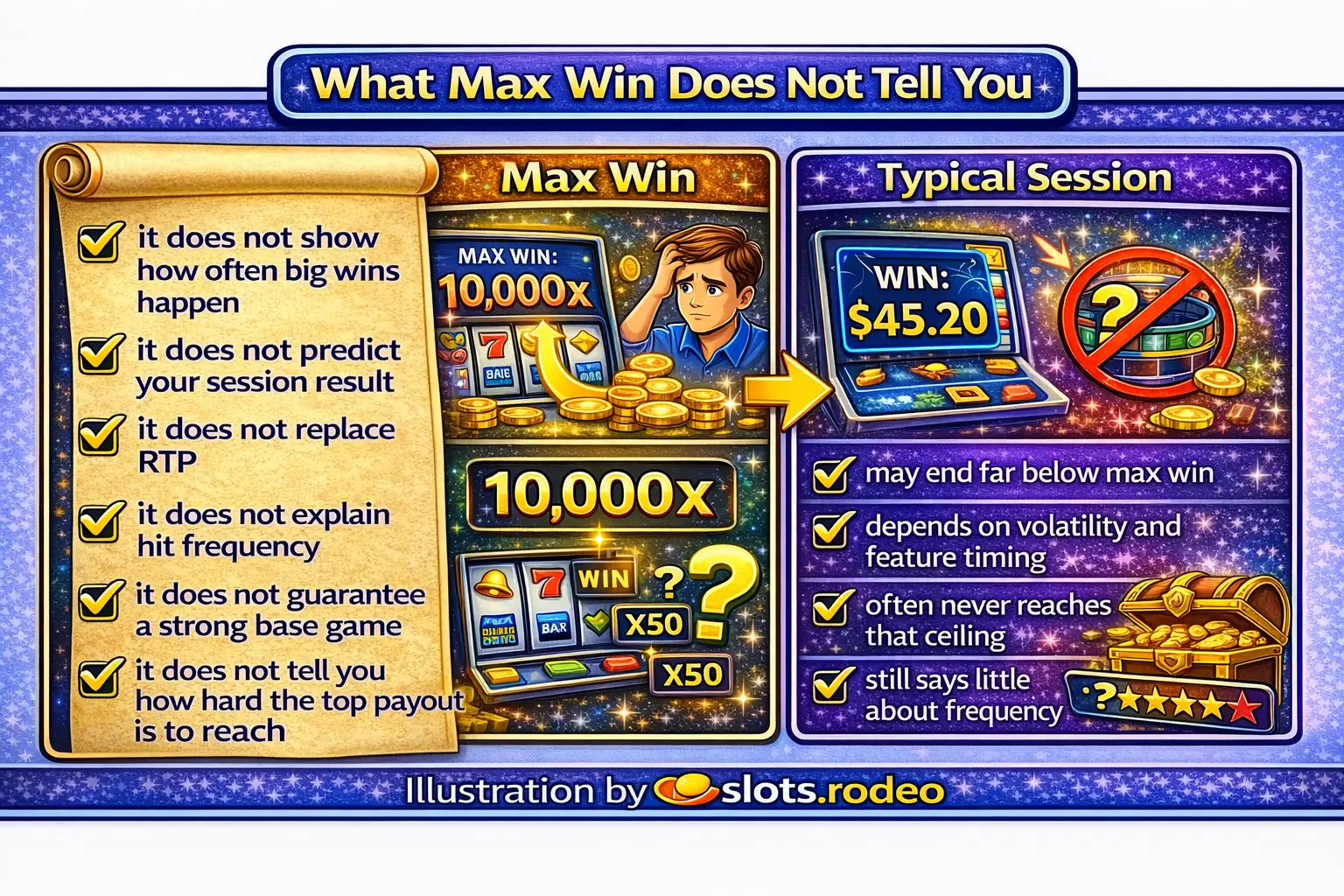
What max win does not tell you
Max win is useful, but limited.
It doesnottell you:
- how often strong wins happen
- how often the bonus triggers
- what a normal session looks like
- how much the average bonus pays
- whether the base game is active or quiet
- how much of RTP sits in the feature
- how volatile the slot feels in practice
How to read max win correctly
The best way to use max win is to treat it as aceiling metric.
It helps answer:
- how high can this slot theoretically go?
- is this a low-cap or high-cap design?
- does the game offer modest or very large top-end range?
It doesnotanswer:
- how often will I win?
- how often will I hit the feature?
- what should I expect in a short session?
- is this slot smoother than another one?
For those questions, you need other metrics and rule details.
Quick comparison: what max win can and cannot do
| Useful for | Not enough for |
|---|---|
| Understanding payout ceiling | Predicting normal results |
| Comparing top-end slot range | Estimating bonus frequency |
| Identifying capped upside | Judging RTP |
| Seeing whether a game is low-cap or high-cap | Explaining average session value |
Understanding payout ceiling
Comparing top-end slot range
Identifying capped upside
Seeing whether a game is low-cap or high-cap
FAQ
Common questions about this topic.
It means the highest theoretical payout the slot can produce under its rules.
No. It is a ceiling, not a normal or likely result.
Not automatically. It only means the slot allows a larger top-end outcome.
No. RTP is long-term theoretical return. Max win is the highest possible payout cap.
Often no. In many slots, the maximum result depends on bonus features, multipliers, or other special conditions.
