

Evaluating two slot games may seem straightforward, yet many players approach it incorrectly.
A frequent error is focusing on a single statistic, like RTP, maximum win, or hit frequency, and assuming that represents the entire picture. This method is flawed. Two slots can have the same metric and still function quite differently in actual play.
An effective comparison should assess the game in its entirety: how wins are generated, where the greatest value lies, how features operate, and the likely experience during short sessions.
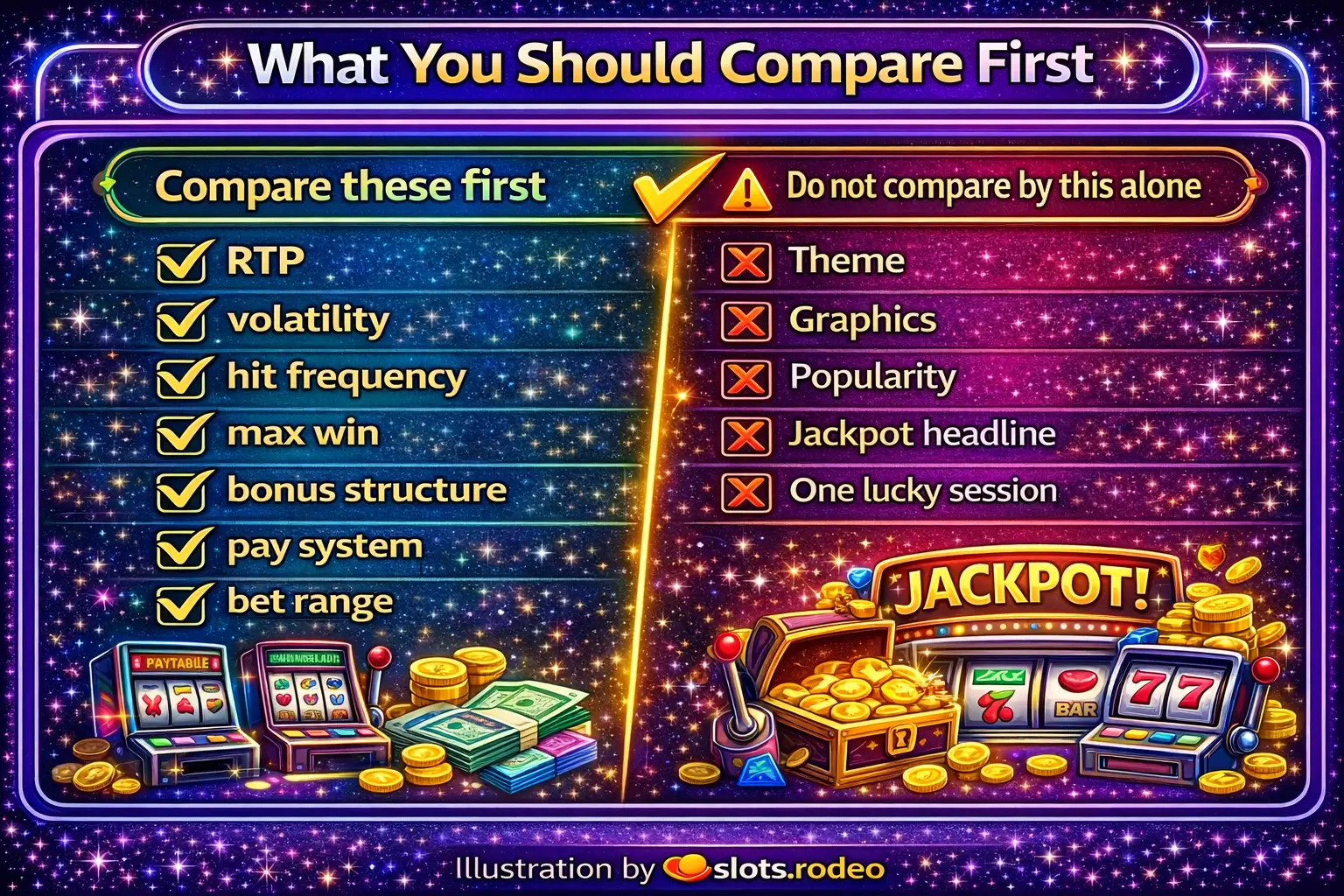
Reasons why many slot comparisons are flawed
Numerous rapid comparisons falter because they focus solely on one visible metric.
For instance:
- Slot A has a higher RTP, therefore it must be superior
- Slot B has a larger maximum win, so it must be more powerful
- Slot A has a higher hit frequency, so it must be more reliable
- Slot B features more bonuses, so it must pay out better
These deductions are overly simplistic.
A slot is not determined by a single standout statistic. It is characterized by how multiple elements interact:
- RTP
- volatility
- hit frequency
- max win
- win system
- bonus structure
- feature reliance
- symbol and payout distribution
That’s why two slots ought to be compared assystemsnot merely as individual numbers.
Begin with the game's structure, not just the standout statistic.
Before comparing any statistics, determine what types of slots you are actually examining.
Ask:
- Do both titles utilize paylines, ways to win, or cluster payouts?
- Are they both fixed-format slots or does one incorporate Megaways?
- Do both games place a significant emphasis on free spins?
- Is one more focused on base-game play while the other prioritizes bonus features?
- Do they both have a comparable depth of features?
When the structures differ greatly, the same metric might not translate the same way in practice.
For instance, two slots may both indicate a 96% RTP, yet one could yield more through frequent small base-game payouts while the other might offer greater value in rarer bonus rounds.
What should be compared initially
The ideal starting point is the fundamental design profile.
| Comparison point | Why it matters |
|---|---|
| Win system | Tells you how wins are formed |
| RTP | Shows long-term theoretical return |
| Volatility | Helps explain payout distribution |
| Feature composition | Shows where much of the game's value sits |
| Max win | Shows top payout ceiling |
| Win frequency | Helps explain session rhythm |
| Reliance on bonuses | Shows whether the game relies heavily on feature access |
Win system
RTP
Volatility
Feature composition
Max win
Win frequency
Reliance on bonuses
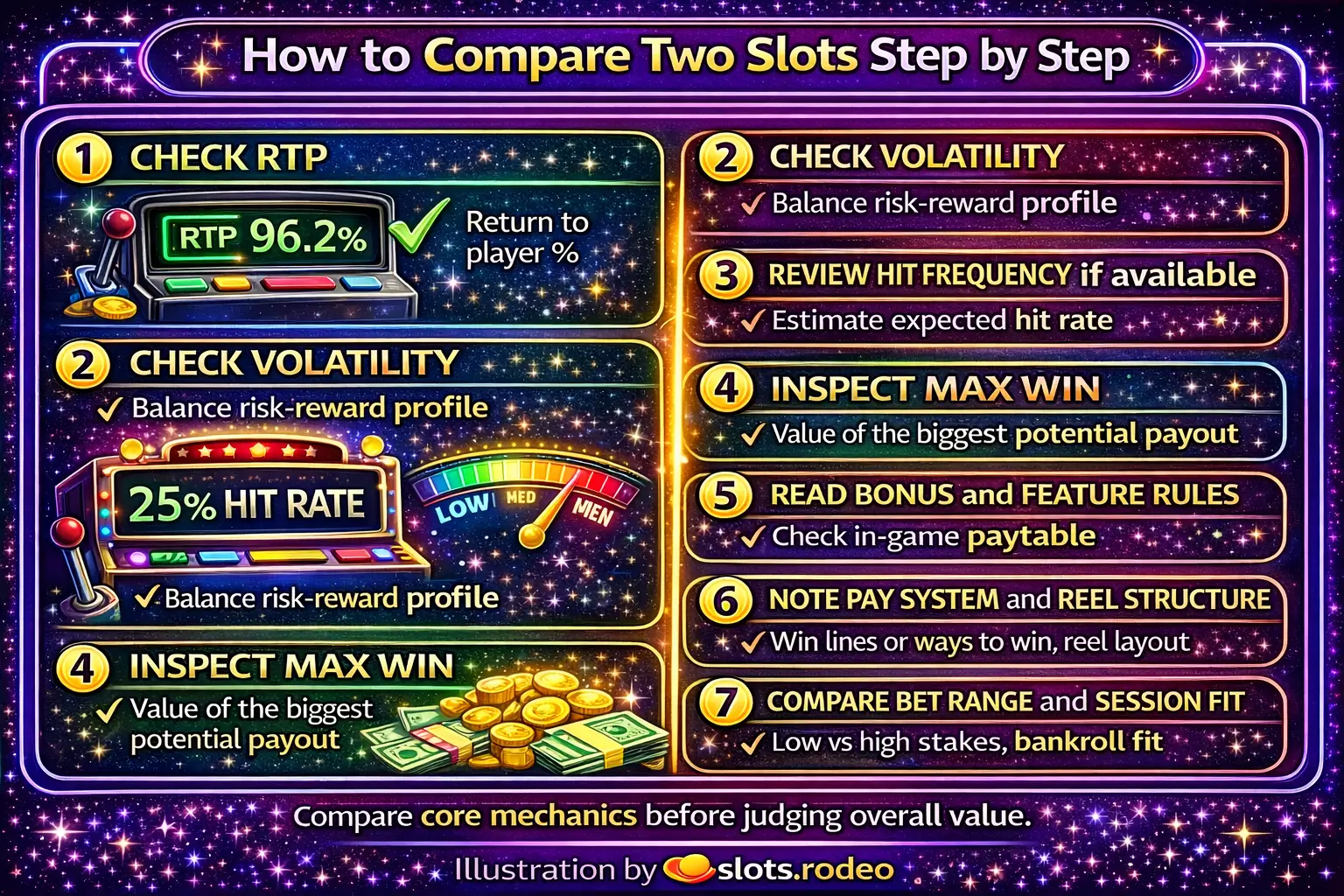
Step 1: Analyze the winning mechanism
Prior to examining payout statistics, evaluate how each slot generates wins.
Common winning systems include:
- fixed paylines
- ways to win
- Megaways
- cluster pays
This distinction is crucial as the reel layout is perceived differently across systems.
Key inquiries to consider:
- does the slot employ predetermined line patterns?
- does it track consecutive reels?
- does it utilize connected groups?
- does the height of the reels vary with each spin?
For example, if Slot A operates on fixed paylines and Slot B utilizes Megaways, they could feel distinct even before evaluating other metrics.
Step 2: Assess RTP, but interpret it correctly
RTP holds significance, but only when understood in context.
When evaluating RTP:
- verify the specific RTP version rather than relying on a general reputation figure
- keep in mind that RTP reflects long-term theoretical returns
- avoid viewing a minor RTP difference as the sole basis for comparison
- do not rely on RTP for short-session forecasts
Example:
| Slot | RTP |
|---|---|
| Slot A | 96.1% |
| Slot B | 95.8% |
Slot A
Slot B
This variance is important, yet it doesn't provide a complete picture. Slot A might still seem more challenging during short play if its value is primarily accessed through bonus features or exhibits more variability in outcomes.
While RTP is essential for analysis, it should not be the sole focus.
Step 3: Assess volatility
Volatility provides insight into how a slot allocates its payouts.
Consider these questions:
- does the slot primarily offer smaller, frequent wins?
- does it emphasize fewer, more substantial payouts?
- does it depend on occasional significant bonus rewards?
- does the base game remain engaging, or can it feel uneventful?
Two slots can display comparable RTP yet possess markedly different volatility characteristics. This distinction can significantly impact the player's experience during short gaming sessions, often more so than RTP alone.
A straightforward comparison might resemble this:
| Slot | RTP | Volatility profile |
|---|---|---|
| Slot A | 96.0% | Medium |
| Slot B | 96.0% | High |
Slot A
Slot B
Identical RTP, yet a different experience.
Step 4: Analyze where value is concentrated
This is among the most valuable evaluations, yet frequently overlooked.
Inquire where the slot allocates most of its effective value:
- base game
- free spins
- bonus round
- multiplier features
- jackpot elements
- cascading payouts
- symbol enhancement features
If Slot A generates more returns through base-game wins while Slot B relies on feature activations, the gaming experiences can vary significantly, even if other statistics appear similar.
This often explains why players perceive two slots in contrasting ways.
Step 5: Evaluate free spins and bonus features
Numerous contemporary slots heavily integrate their identity within the bonus features.
Key questions:
- What initiates free spins?
- How many spins can be received?
- Is it possible to retrigger free spins?
- Are multipliers utilized during the feature?
- Does the bonus alter the behavior of symbols?
- Is there a single bonus mode or multiple options?
A slot featuring basic free spins differs from one that introduces sticky wilds, increasing multipliers, or mode selection during free spins.
This distinction should be included in the evaluation.
Step 6: Evaluate the maximum win, but avoid overstating its significance.
The maximum win is important as it indicates the potential payout limit.
However, it warrants careful interpretation.
A slot offering a maximum win of 50,000x doesn't inherently outperform one with a 5,000x max win; it simply has a greater potential upper limit.
Consider these inquiries:
- Is the maximum win dependent on infrequent feature triggers?
- Does the slot require stacked multipliers to achieve this win?
- Is the game clearly weighted towards high payouts?
- Is the maximum win only achievable under optimal circumstances?
The maximum win helps gauge potential returns, but it offers limited insight into typical gameplay.
Step 7: Assess hit rhythm, not merely the number of hits.
If hit frequency data is accessible, leverage it to gauge how gameplay sessions might unfold.
Ask:
- Does the slot generate regular small wins?
- Are extended losing streaks likely to be experienced?
- Does the game provide numerous partial wins?
- Do wins occur frequently yet remain small in value?
This is significant as a slot that "hits regularly" may still yield lower average returns per winning spin.
When analyzing hit frequency, it is essential to relate it to both payout size and feature dynamics.
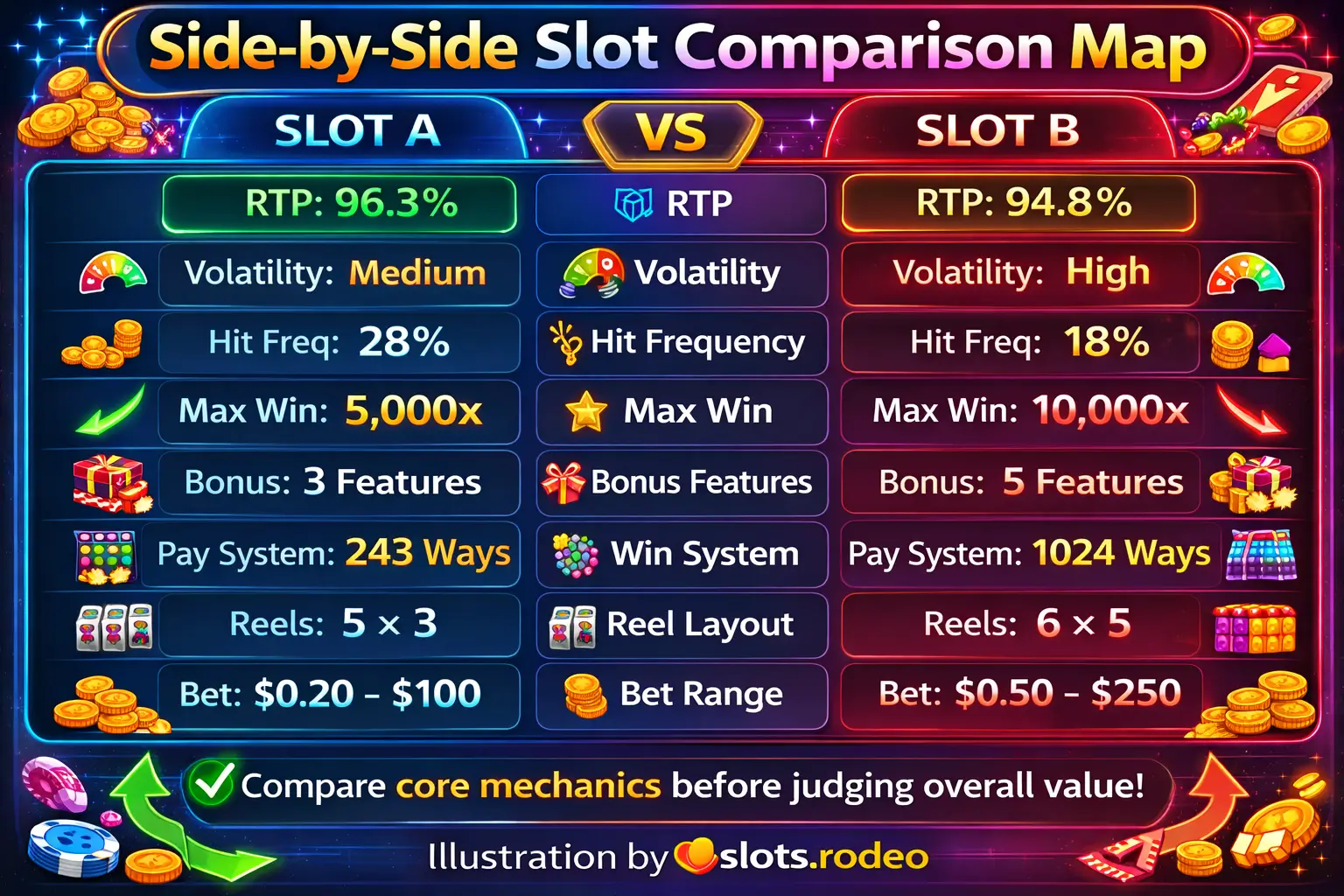
Comparison overview chart
A comparative analysis is often most effective when presented in a tabular format.
| Comparison area | Slot A | Slot B | What to watch |
|---|---|---|---|
| Win system | Fixed paylines | Megaways | Structure changes how wins are formed |
| RTP | 96.1% | 95.8% | Small edge to Slot A, but not enough alone |
| Volatility | Medium | High | Slot B may feel harsher but more top-heavy |
| Highlighting features | Balanced | Bonus-heavy | Slot B may depend more on feature access |
| Max win | 5,000x | 20,000x | Slot B has higher ceiling, not necessarily better average results |
| Overall session experience | More stable | More uneven | Depends on player preference |
Win system
RTP
Volatility
Highlighting features
Max win
Overall session experience
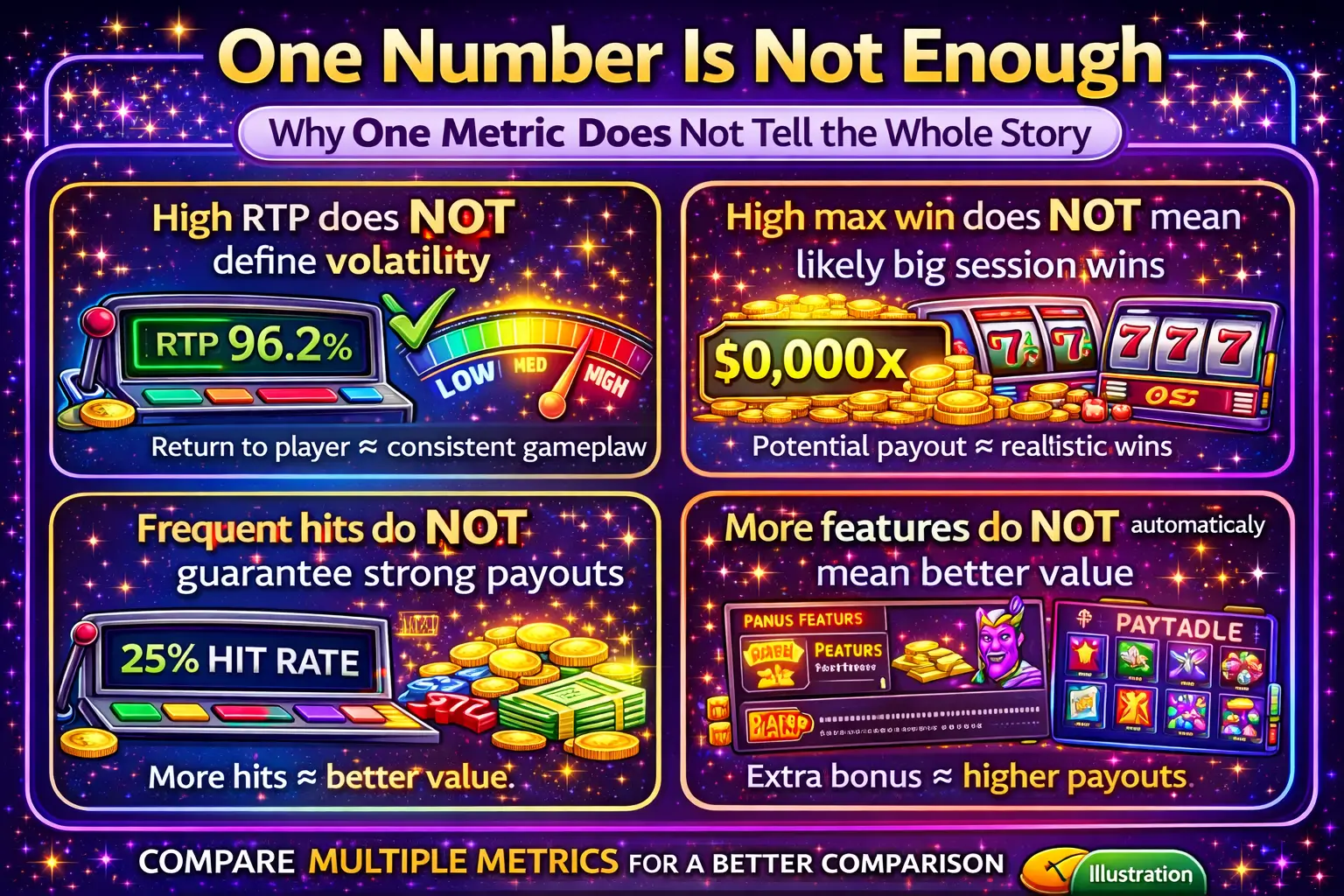
Relying on one statistic is insufficient
This is a fundamental principle.
No single metric can adequately compare two different slots.
Here's the reasoning:
| Metric | Useful for | Not enough for |
|---|---|---|
| RTP | Long-term return comparison | Session feel, bonus timing, volatility |
| Volatility | Payout distribution style | Exact return value |
| Frequency of hits | Win rhythm | Average payout quality |
| Max win | Ceiling comparison | Typical outcomes |
| Depth of bonus features | Feature profile | Full math model |
RTP
Volatility
Frequency of hits
Max win
Depth of bonus features
Incorrect comparison versus accurate comparison
An ineffective comparison might state:
- Slot A offers 96.2% RTP, making it superior to Slot B with 95.9%
- Slot B has a maximum win of 25,000x, indicating it is more robust than Slot A
- Slot A includes more features, which should lead to more frequent payouts
A more effective comparison would be:
- Slot A features a marginally elevated RTP.
- Slot B offers a greater maximum win potential.
- Slot A appears to be more dynamic in the base game.
- Slot B appears to be more reliant on bonus features.
- Slot A might provide a more consistent experience.
- Slot B could be perceived as more top-heavy.
This constitutes a valid comparison as it values overall structure rather than reducing everything to a single metric.

Essential questions for effectively comparing two slots.
When evaluating two games, consider these relevant questions:
- Do both slots employ the same winning mechanism?
- Is one slot comparatively more focused on bonuses?
- Is the difference in RTP significant or negligible?
- Does one slot evidently exhibit greater volatility?
- Is one slot designed with higher maximum winning potential?
- Does one slot seem more engaging during the base game?
- Does one slot depend more heavily on free spins, multipliers, or jackpot features?
These inquiries typically provide deeper insights than any single figure could.
An illustrative example of comparison.
Consider two slots:
Slot A
- 96.2% RTP
- medium volatility
- fixed paylines
- 5,000x maximum win
- active base game
- standard free spins
Slot B
- 96.0% RTP
- high variance
- Megaways
- 20,000x maximum win
- more subdued base gameplay
- enhanced feature multipliers
A superficial analysis might suggest Slot A is superior due to its higher RTP.
A more nuanced analysis would indicate:
- Slot A offers a slight return advantage
- Slot B has a greater maximum potential
- Slot A might provide a more consistent experience
- Slot B could depend more on feature-driven fluctuations
- These slots are designed for distinct playing styles
This is the appropriate method for comparison.
Frequent errors when evaluating two slots
Focusing solely on RTP
Informative, yet not comprehensive.
Focusing solely on maximum win
Indicates potential, not typical gameplay.
Neglecting the win mechanics
The winning structure influences the entire gameplay experience.
Assuming more features equate to greater quality
An increase in mechanics does not ensure better outcomes.
Overlooking the actual value of the slot
Slots that emphasize bonuses versus those focused on base gameplay can provide vastly different experiences.
Mistakenly comparing various RTP versions
The same slot title can be available in multiple RTP settings.
Objectives of an effective slot comparison
An effective comparison should address the following inquiries:
- which slot offers a higher theoretical return?
- which slot demonstrates more consistency or inconsistency?
- which slot is more packed with features?
- which slot presents a higher potential payout?
- which slot is simpler to interpret and comprehend?
- which slot aligns better with your preferred session style?
This approach is far more insightful than merely labeling one slot as "superior."
FAQ
Frequently asked questions regarding this subject.
There isn't a single most crucial metric. RTP, volatility, winning mechanics, feature layout, and maximum win should be considered collectively.
No. RTP is informative, but it does not clarify session experience, volatility, feature reliance, or payout limits.
No. Maximum win indicates the potential cap, but it reveals little regarding standard gameplay in isolation.
Since paylines, Megaways, ways to win, and cluster pays create wins in various ways, this affects game dynamics.
Yes. They can vary in volatility, bonus reliance, feature configuration, and winning arrangement.
